

Although the Official IRA had declared a ceasefire in May of 1972 following its murder of Ranger William Best in Derry, it ‘reserved the right’ to retaliate by violence against British forces for a time, but especially reserved the opportunities to raise revolutionary funds by robbing banks and putting the squeeze on particular businesses.
It retained all of its arsenal which it required to sometimes fight feuds with and kill ex-members who formed the Provisional IRA and later the cognomen-updated People’s Liberation Army aka the National Liberation Army aka the Irish National Liberation Army.
In June 1974, the Official IRA publicly admitted the murder of one of its members, Paul Tinnelly, whose “criminal activities were designed… for his own personal profit” according the ethical and sanctimonious Stickies. (Irish Times, 1 June 1974).
I am perhaps a cynic in believing that if all of those volunteers of the OIRA, PIRA and INLA had been murdered who profited personally from robberies and extortion, the ranks of all of them would have been thinned considerably even before many of their revolutionaries went on the lucrative payrolls of various security agencies.
On September 6, 1974, the Official IRA in Belfast sent out a four-man unit to rob the Ulster Bank at Rathcoole and the take was the measly sum of £681 carried in a tartan holdall from the bank but dropped on the street when the robber carrying it stumbled and fell as an RUC Inspector, William Elliott, challenged the bank robbers from across the street.

A woman civilian passing by grabbed the tartan holdall and began stuffing back into it money that had spilled onto the ground.
Shots rang out and 48-year-old Inspector Elliott was hit in the chest and died shortly afterwards in hospital. The bungling Sticky robbers escaped without the loot, but with an unexpected ‘kill’.
Shortly afterwards John Gerard McCullough was arrested and questioned. He was a 19 year-old-labourer from Dandy Street in Newtownabbey.
Facing questions about a robbery and murder, according to the Belfast Telegraph, McCullough begant to sing a cappella:
Interrogation & Implication
Yesterday one of a team of detectives engaged in the investigation told the no-jury trial before Mr. Justice McGonigal, of interviewing McCullough on September 13. He said he told the accused he understood he had already made certain statements to other police and he intended asking him certain questions.
McCullough replied: “I have already said I was there but I didn’t have a gun.”
Asked by the detective who were the other three men with him during the raid, McCullough was alleged to have replied: “I don’t know the two from Belfast but the other was Bennett from Merville.”
Questioned on what Bennett he referred to, he said: “Ronan.”
Asked did he know Ronan Bennett very well, McCullough said: “No, not very well. I have only seen him a few times since I came over from England.”
Asked by the detective who organised the bank raid, McCullough replied: “I don’t know. Ronan Bennett called at my house after tea-time on Thursday night and told me there was a job on for Friday morning. He told me to be at the bottom of Dandy Street at 11 a.m.”
Asked if he did this, McCullough said: “I was down on the Shore Road about 11 and they picked me up.”
Who was in the car?
McCullough: “Bennett and the ginger-haired fellow were in the back seat. The other fellow was driving and I got into the front passenger seat beside him. You know what happened at the bank.”
Asked what part he played at the bank, McCullough answered: “I carried the money bag.”
Questioned about who fired the shots at Inspector Elliott he replied: “I’m not sure. It was either Bennett or the ginger-haired fellow or maybe both.”
Bennett’s Don’t Knows & Denials
The detective said that he saw 18 year-old-student Bennett for the first time on the morning of September 13:

Asked if he had called at McCullough’s house at tea-time on September 5, Bennett replied: “I don’t know McCullough and I don’t know where he lives.”
Told where McCullough lived in Dandy Street, Bennett said: “I only know a couple of people from Bawnmore and I don’t know anyone from Dandy Street.”
Bennett denied he was a member of the Official IRA and said he did not know anyone who was involved in the IRA.
Co-defendant’s Guilty Pleas
Ronan Augustine Hilary Bennett was denying the murder of Inspector William Elliott and the bank robbery charge.
His co-defendant, McCullough, was pleading guilty both to membership of the Official IRA and to the robbery of £681, but was denying Inspector William Elliott’s murder.
The Belfast News Letter reported:
A woman yesterday told Belfast City Commission how she tackled a member of a bank robbing gang and snatched back what had been stolen.
The woman was giving evidence during the second day of a murder trial in which two teenagers, Ronan Bennett (18), student, of Merville Garden Village, Newtownabbey, and John McCullough (19), of Dandy Street, also Newtownabbey, are charged with murdering RUC Inspector William Elliott at Rathcoole on September 6 last.
The woman, who was giving her evidence, told the court that she was returning home after doing some shopping when she walked into the bank raid. From behind a car she saw three men emerge from the bank. One carried a tartan holdall.
“A policeman came from behind another car and he appeared to challenge them,” she said. The man carrying the holdall stumbled and she grabbed it. Then there was shooting.
“While I was retrieving some of the spilled money, I looked up and saw the police inspector had his gun in his hand as if he was trying to take aim. He appeared to take a dive for cover behind a car. There was another couple of shots after he hit the ground.”
She later identified the defendant Bennett as the man who did the shooting and the co-accused McCullough as the man carrying the holdall.
Both defendants deny murdering Inspector Elliott.
McCullough admits the armed robbery of £681 from the bank and being a member of the Official IRA.
Bennett Convicted of Murder
On Thursday, 29 May, 1975, Lord Justice McGonigal convicted Ronan Bennett of the murder of Inspector William Elliott and of the robbery of £681 from the Ulster Bank.
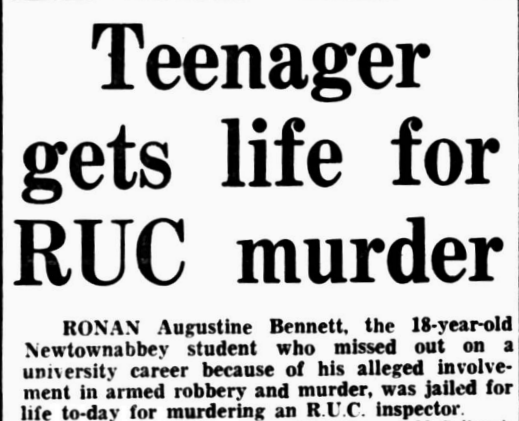
The Belfast News Letter reported:
Eighteen-year-old student, Ronan Augustine Bennett, from Merville Garden Village, Newtownabbey, was yesterday jailed for life for the murder of RUC Inspector William Elliott (48), who was shot dead during a bank hold-up at Rathcoole last September.But a co-accused, John Gerard McCullough (19), a labourer from Dandy Street, also Newtownabbey, was acquitted of the murder charge, but jailed for six years for armed robbery and being a member of the IRA.
In a reserved judgment at Belfast City Commission, Lord Justice McGonigal said he was satisfied beyond all doubt that Bennett was guilty of murder and also of taking part in the bank raid. Bennett was also given a 10-year sentence for armed robbery.
Both accused had pleaded not guilty to murdering Inspector Elliott outside the Ulster Bank at The Diamond, Rathcoole, on September 6.
McCullough, during his trial last week, admitted the armed robbery of £681 from the bank and membership of the Official IRA. Bennett denied the armed robbery charge.
In acquitting McCullough on the murder charge, Lord Justice McGonigal said that while he found it difficult to accept that a man could go out on an armed robbery believing that guns were being carried but not to be used if the raiders were opposed or attempted to escape, he could not, having regard to the heavy onus on the Crown, say he was satisfied beyond reasonable doubt that McCullough had the necessary knowledge and intent and was a consenting party to a plan that involved knowledge and intent.
Accordingly, he acquitted McCullough on the murder charge and said that having regard to the evidence given by police as to McCullough’s character and degree of involvement, which was in accord with McCullough’s own evidence to the court, he considered the justice of the case was met by his plea of guilty already entered to the other charges – armed robbery and belonging to the IRA.
Lord Justice McGonigal told McCullough he took into account all that had been said by his counsel and by the police which indicated he was a person who, in the ordinary way, would not have got involved.
Lord Justice McGonigal told Bennett he considered he bore the main responsibility for what happened.
Bennett, he said, played a substantial part in what happened. He was an intelligent person who had brought the whole thing on himself and allowed himself to be carried away by misguided idealism. Lord Justice McGonigal said he would make no recommendation to the term Bennett should serve.
Senior counsel for Bennett indicated to the court that as far as his client was concerned, the matter would be going to another tribunal.
Bennett’s Successful Appeal to British Justice
Ronan Bennett’s appeal was heard in December of 1975, only 7 months after his conviction, but not before he had attempted to escape – and nearly escaped – from the Maze prison in August of 1975 and while his appeal was pending.
On December 5, 1975, the Belfast Telegraph reported:
THE Appeal Court today gave its reasons for an 18-year-old student sentenced to life imprisonment for the murder of an RUC Inspector having his conviction quashed.
Ronan Augustine Hilary Bennett of Merville Garden Village, Newtownabbey. convicted of the murder of Inspector William Elliott in May last, had the conviction quashed earlier this week.
Inspector Elliott was shot when he went to investigate a bank robbery at The Diamond, Rathcoole, on September 6, 1974, and died in hospital.
Today Lord Justice Jones, who with Lord Justice Gibson and Mr Justice O’Donnell, had heard Bennett’s three-day appeal, gave the reasons for the court’s judgment.
It had found, he said, that forensic evidence was frail and alleged verbal admissions inadequate.
They had examined the evidence of the sole identification witness and had found it defective in four major areas.
Four bank officials, including a manager, had clearly stated that the robber had a beard, but this witness was adamant that he had not.
The witness had made a statement to the police two days after the robbery that the robber was wearing a bomber jacket. Later, when depositions were being taken, she changed this to ‘a dark charcoal duffle coat.’ At that stage she had also said the robber’s hair was ‘dark and longer than it is today.’ At the trial, while under cross-examination, she stated that the hood of the duffle coat was up, and could not say anything with regard to the robber’s hair.
Lord Justice Jones said this witness was also adamant that in the car used for the robbers’ escape, the front seat was occupied by a woman and a child. This evidence, they held, was in direct conflict with other evidence, yet was quite clearly given by the witness, who had also mentioned that the child was about 18 months old and was standing on the woman’s knee, rather than sitting.
There were further discrepancies of a minor nature in her evidence, but their Lordships found it unnecessary to go into this, as they considered no identification evidence could ever be totally free from minor inconsistencies.
It was well established in law, said Lord Justice Jones, that the question of identification had to be approached with caution, particularly when the witness did not know the person and only saw him for a short time. But they stressed that the caution must be greater still when the identifying witness gave versions containing inherent inconsistencies.
The trial judge was under statutory obligation to give reasons for his judgment, but their Lordships did not think that he had to necessarily give detailed reasons. They felt, however, that when an identifying witness vital to the Crown case gave evidence containing contradictions and inconsistencies, the trial judge must, in their view, give indications in his judgment as to how these contradictions and inconsistencies could be resolved.
Lord Justice Jones said they sympathised with the trial judge who had tried to take a view of the whole case, but they could not find any method of resolving these inconsistencies and contradictions, and he therefore had to quash the conviction.
Bennett, who faces a further charge of attempting to escape from custody, remains in custody.
In fact, the lenient British court granted Bennett bail on December 12, 1975, a week after judges explained the reasons for quashing his murder conviction.
Bennett’s Attempted Maze Escape
Three months after Bennett’s conviction for murder, he attempted a daring escape from a compound in the Maze prison/Long Kesh that necessitated illegally forcibly detaining against his will a fellow prisoner who was due to be granted bail at a court hearing.
A group of six prisoners illegally and forcibly detained remand prisoner Matthew Leyden by tying him to a bed after they had illegally and forcibly removed his clothing and glasses which Bennett donned and then presented himself to the prison authorities for transport to the bail court in the guise of the illegally and forcibly detained man.
Bennett made it all the way to the dock of the court and was granted bail but as he left the dock, he was recognised by an RUC detective and legally detained.
The Belfast Telegraph reported the court hearing:
A STUDENT whose conviction of murdering a policeman and armed robbery was later quashed, tried to impersonate another remand prisoner to escape detention, Belfast City Commission was told today.
Ronan Augustine Hilary Bennett, (20), of Merville Garden Village, Newtownabbey, was said by the Crown to have appeared at
Belfast Magistrate’s Court on August 4 last under the name of the other prisoner.He was today bound over in the sum of £10 to be of good behaviour for two years on pleading guilty to attempting to escape from the Maze.
According to his counsel, Bennett’s attempt was born out of his frustrations at being in custody for up to a year for a crime which
he claimed he had not committed.Crown counsel told the was convicted at the City Commission of murder for which he was given life and 10 years for robbery.
On August 4, although an appeal was pending, he was being detained in the Maze Prison.
Another prisoner called Matthew Leyden was due at Belfast Magistrate’s Court for remand. He had been granted High Court bail the previous day and was going to avail himself of it. However Bennett substituted himself for Leyden and almost succceeded in getting away. Bennett arrived at Belfast Magistrate’s Court and appeared in the dock under the name of Leyden, but a police officer realised that the wrong person was in the dock.
Counsel said that Leyden had been compelled by six men to agree to allow Bennett to take his place.
He added that Bennett’s conviction of the murder and robbery had been quashed subsequently by the Court of Criminal Appeal in Belfast and he had been on bail since December 12 on the attempted escape charge.
Defence counsel said that at the time of his arrest in 1974, Bennett was waiting for the start of term at Queen’s University where he had been accepted to study history. He was arrested in September of that year and held in custody until his trial in May last.
At all times he had protested his innocence of the crime of both murder and armed robbery and any complicity in them. On his conviction an appeal was lodged.His attempt to escape was born out of his frustrations that he had at all times claimed he was innocent notwithstanding he had been convicted and was alleged to have said that he would “do anything to get out of Long Kesh”.
Bennett was not the organiser although he participated in the scheme to escape. The reason he was singled out was not for any sinister motive but merely because he had a physical resemblance to Leyden, who was tied to his bed in his cell.
Counsel added that Bennett had served over 15 months in custody.
Judge Babington said that attempting to break prison was a serious charge, but when one looked at how Bennett went ahout it, it became even more serious.
He had got together with other persons to use force and restrain one of his co-prisoners to get himself released.
However, he was not going to make his problems worse by imposing a sentence as he would normally do and would bind him over.
It was an extraordinarily lenient outcome from British Justice for Ronan Bennett to a charge of attempted escape that involved the illegal and forcible detention of a fellow prisoner after forcibly taking his clothing and glasses, then tying him to a bed and setting off to impersonate him at court to get his release on bail and almost escaping from custody – to be merely bound over for two years of good behaviour and a £10 fine.
Ronan Bennett should get down on his knees and hail British Justice twice over!
How is it that Ronan Bennett feels no irony or shame in coming to Belfast to talk alongside Gerry Adams about “illegal detentions” when Bennett himself pleaded guilty to an escape charge that was built upon an illegal and forcible detention of a fellow prisoner and when Gerry Adams has repeatedly stated his support for the IRA’s “right” to oppose British rule in Northern Ireland that included, on the IRA’s part, multiple illegal and forcible detentions of fellow Irish and British citizens, Catholic and Protestant, many of whom were tortured, extra-judicially “executed” and even had their corpses “disappeared” by the IRA executioners – with corpses of many of these victims still not returned by the IRA to their loved ones for Christian burial?
Have you nothing better and less shameful to be doing, Ronan?

