Prominent Irish journalist, author, editor and broadcaster Tim Pat Coogan [The IRA (1970), Ireland Since the Rising (1966), On the Blanket (1980)] is still with us at or about the age of 91 years.
In his seminal book, The IRA, he recorded on page 367:
It is literally true, for instance, that in August 1969 the only weapons known to be available to the IRA were ten guns.
Subsequent to the Bombay Street burnings, Jack McCabe, with another Republican sympathizer, Myles Shevlin, a solicitor, smuggled in some guns to the North which had been cached since the 1950s campaign – one of them a Schmeisser machine-gun.
McCabe, a veteran of the forties who subsequently blew himself up when a spark from a shovel with which he was mixing explosives on the floor of a garage in his home on the Swords Road, Dublin, set the explosives off, injuring him terribly and fatally, was probably the main IRA bomb supplier of the period.
His eyes and testicles were blown away but on his deathbed he used his last strength to give Shevlin details of what had gone wrong so that someone else would not make the same mistake.
‘An iron man, ‘Shevlin told me, ‘an iron man.’
After his death, on 30 December 1971, the Northern hydra was to ensure that many others with expertise gained in armies both at home and abroad would be found to follow in his footsteps.
In his comprehensive biography of IRA and Sinn Féin veteran, Ruairí Ó Brádaigh, entitled ‘The Life and Politics of an Irish Revolutionary‘, American sociology professor Robert W. White wrote:
The escape was a morale booster for a cause that continued to suffer. Ó Brádaigh had escaped hoping to rejoin the campaign as a volunteer. But while he and O’Connell were lying low, Sean Cronin, Mick McCarthy (a member of the Army Council), and three members of IRA general headquarters staff were arrested and interned. The arrests hurt the IRA, which was very much centered on Cronin.
A temporary three-man Army Council remained in charge – Chief of Staff John Joe McGirl was joined by Myles Shevlin, a solicitor from Carlow who was Cronin’s adjutant general, and Paddy Murphy, from Kilkenny.
After waiting a couple of weeks, Ó Brádaigh made contact with the local IRA, who sent word to general headquarters, and a meeting was arranged. To his surprise, he was elected chief of staff. His initial reaction was that he should have stayed in the Curragh. In fact, he was a likely choice. At age 26, he was young, fit, and had operational experience. He was also the only member of the December 1956 Army Council who was at large. And because he was on the run, he could devote all of his time to the IRA.
John Joe McGirl, Paddy Murphy, and Myles Shevlin remained on the council. Later, Paddy Mulcahy of Limerick was co-opted, as was another person, from County Down. The seventh member was Dáithí O’Connell.
Solicitor Myles Shevlin was not merely an IRA volunteer, he was Adjutant General of the IRA and a member of the IRA’s Army Council.
Clearly in the IRA’s mind there was no bar preventing a solicitor acting for clients while acting for the IRA – all of those who for many years believed that Shevlin was an IRA volunteer while practising as a solicitor were quite right – he was both an IRA volunteer and an IRA liar.
During all the years of his secretive IRA activity, his IRA comrades always denied that he was in the IRA – why wouldn’t they? They were sworn to lie about his IRA membership.
In common with all other IRA volunteers, Shevlin was obliged to tell lies about his IRA activities – to publicly deny his IRA membership while in private and in secrecy he was a very prominent IRA solicitor and IRA volunteer for many years.
Myles Shevlin was chosen by the IRA Army Council to travel to London with IRA representatives who met secretly with Conservative Secretary of State for Northern Ireland, William Whitelaw, in the famous Cheyne Walk talks in July of 1972.
Shevlin publicly denied that he was the IRA solicitor at the Cheyne Walk talks, but later admitted it when his name and attendance were acknowledged by both the IRA and the Brits.
He had no embarrassment at being unmasked as a very recent liar. In 1974, British author Gerald McKnight interviewed Shevlin (pp.72-76) for his book, ‘The Terrorist Mind‘, in which Shevlin discussed both his recent lies, his attendance at the Cheyne Walk talks and his IRA activities:
Myles Shevlin, a Dublin solicitor, is Republican Ireland’s darkest horse. Before we met, I had heard it rumoured that he had been an undisclosed ‘sixth man’ at the highly secret meeting in London between William Whitelaw and IRA chiefs during early July 1972. To me, he did not deny this, though he once issued an absolute refutation of it to a British newspaper.
‘I may as well admit it now,’ he said. ‘It’s fairly well known that I did go to London, to the meeting in Cheyne Gardens with Sean MacStiofain, David O’Connell, Seamus Twomey and the others. As a matter of fact, I don’t think the British took to me at all.’
He was a typical IRA volunteer – he was prepared to tell as many lies as were required For The Cause.
Myles Shevlin was the IRA’s solicitor of choice in the Free State. If you were an IRA volunteer arrested by the Free Staters back then, you didn’t need even to ask for Myles – he would appear at the courthouse or police station requesting to see his client – the client who hadn’t yet asked for his services.
When Irish Guards deserter, Kieran McMorrow – named by British police as wanted for questioning (along with Marlene Coyle) in relation to the February, 1974, M62 Coach Bomb which killed 9 young British soldiers, and the young wife and two infant children of one of the soldiers – was arrested by Gardaí after a shoot-out at Moneydoo, Swanlinbar, County Cavan in March, 1977, and later appeared at the Special Criminal Court, he asked for a solicitor – and nobody was surprised when Shevlin just happened to be on hand in the Special Criminal Court chasing his fellow IRA volunteer client:
McMorrow who was brought into the dock handcuffed to a Garda, had a chest-length black beard and his hair was tied with a black ribbon.
Addressing the Court in Irish, he asked if there was a solicitor in the Court on his behalf and said he did not mind if the proceedings were in Irish or English. He said he wanted a solicitor to represent him but he had not named one.
He said he was satisfied with Mr. Myles Shevlin, Solicitor, who was present in Court.
After Shevlin had leaned over and whispered his O.C.’s name to him, McMorrow was under the command and control of Óglach Myles Shevlin, solicitor, acting on behalf of the IRA’s GHQ and Army Council.
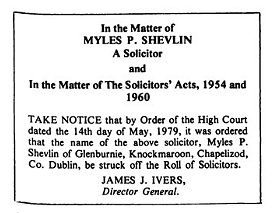
Shevlin was ‘struck off’ the roll of solicitors in 1979 for a year before being re-admitted under restrictions.
By the late 1980s he had joined with Republican Sinn Féin and spoke publicly to criticise those who were betraying the IRA’s historic abstentionist and revolutionary traditions in favour of constitutional politics and the partitionist parliaments of Stormont and Dáil Éireann.
He was pursued later by the Free State authorities for failing to pay sufficient tax on his comfortable income.
In the early 1970s, the IRA’s go-to solicitor in Northern Ireland was P. J. McGrory, more usually known as Paddy McGrory.
It was P. J. McGrory who was chosen by the IRA Army Council to attend the first direct and secret talks with British representatives at Ballyarnett in Derry/Londonderry in June of 1972 to discuss an imminent IRA ceasefire and preparations for the July Cheyne Walk talks in London.
In his 1997 book, ‘God and the Gun: The Church and Irish Terrorism‘, author and journalist Martin Dillon recorded the following about P.J. McGrory:
There are also instances when journalists and broadcasters face the moral dilemma of publishing material which, by its very nature, may compromise a source and place someone in jeopardy. What I call the conflict of conscience versus social obligation was highlighted for me when I unearthed material that exposed the role of a leading Catholic lawyer in the handling of a secret Irish government bank account in the early days of the present conflict.
P. J. McGrory became an international figure during the Gibraltar inquest into the 1988 killing of three IRA activists by the SAS. To help the reader fully understand the background to the P. J. McGrory story, I must now return to matters I wrote about in an earlier book, The Dirty War.
In 1969-70, at the outset of the present Troubles, the Irish government, much to the dismay of its British counterpart, conspired to supply weapons and funds to Catholic defence organisations in Northern Ireland. Within those organisations were nationalist politicians genuinely concerned about the failure of the indigenous security forces to protect the Catholic population, particularly in Belfast where hundreds of Catholic homes were burned and looted by loyalist mobs, often aided by the B Specials.
Within the defence structure there were also respectable Catholic lawyers, businessmen and priests.
However, the most powerful elements were republicans who would eventually use the defence structure to form the Provisional IRA. The Irish government and many others who gave themselves to what became the defence committees were in no doubt that the republican coterie, men with a long-term agenda, had their own views on how monies and weapons should be channelled.
Part of the financing of the defence groups came from a £24,000 payment to Cardinal Conway, which was later ignored when the Irish Parliament set up a committee to investigate its government’s willingness to supply guns and money to organisations that included the IRA.
Several secret bank accounts were set up for the ‘relief’ of Northern Ireland Catholics, one of which was lodged in a bank in Clones.
P. J. McGrory was one of three signatories empowered to draw money from it. After two withdrawals had been made, the names of the account holders were changed to pseudonyms – John White, John Loughran and Roger White.
Two factors led to the change: a desire to obscure McGrory’s involvement, and to permit other unnamed people to withdraw money.
When I was writing The Dirty War, I was unable to name McGrory: if I had, he would have known the identity of my source. Several years later, when I was making a three-part documentary series for BBC2 on the history of the conflict, I decided to unmask McGrory as one of the account holders. In the course of making the series, I encountered BBC internal censorship of my work.
You have to read Martin Dillon’s book for more.
When I was arrested during the IRA’s 1975 bilateral truce/ceasefire in response to which breach the Derry Brigade of the IRA shot dead 19-year-old RUC constable Paul Gray, I was not intending to recognise any court proceedings and did not seek a solicitor.
However, while acting as the ‘A’ Wing Battalion Intelligence Officer in ‘the Crum’ [Crumlin Road Gaol], I was one day called out of ‘A’ wing for a solicitor visit to find P. J. McGrory telling me that he was representing me for a time – and I have no doubt that P.J. was representing primarily the IRA’s interests, not mine.
Following the February 28, 1985, IRA mortar bomb attack on Newry police station that killed nine Royal Ulster Constabulary officers, McGrory was involved in an unseemly public row with another solicitor involving IRA ‘supergrass’ Customs Officer Eamon Collins who had broken during police interrogation and made a ream of statements implicating many others who were subsequently arrested and charged.
The IRA was desperate, naturally, to get Eamon Collins to retract his statements. Collins was initially represented of course by McGrory until one morning he wasn’t.
Before his second remand hearing at court, Collins dismissed McGrory and sought to be represented by solicitor Tony McAndrew who agreed to take him as a client and had two initial consultations with Collins before his second remand appearance on Friday morning, March 22nd.
On the Friday morning, McAndrew arrived early at the court but saw on the lists that Collins’ hearing had been put back to the afternoon, so he left intending to return in time for the afternoon hearing. However, when McAndrew did return, he discovered that Collins had been brought before the court in the morning after all and that McGrory had gotten to him and had been re-instructed by Collins, thereby getting rid of McAndrew.
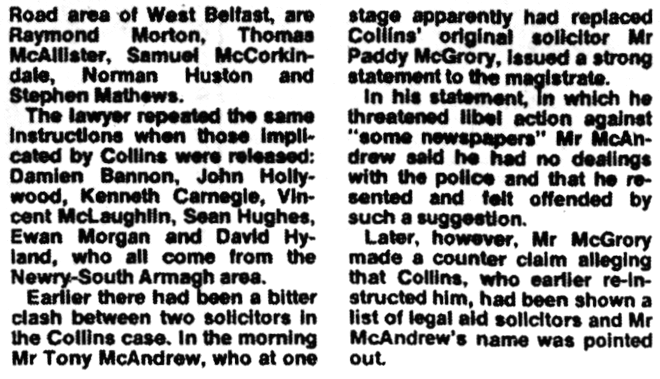
Having negotiated a deal with the IRA for his own safety through the good offices of McGrory, Collins later retracted his statements and all but two of those he had named were freed. Collins himself was also freed, but not to the arrangements previously agreed with the IRA [Killing Rage, pp.334-5]:
However, before we could set off down the tunnel, I heard a voice saying: ‘Hold on. Legal visit.’ I was escorted back into the legal visits room beneath the court.
Paddy McGrory was waiting for me. I was a little surprised. I did not know why he wanted to see me now. ‘Hello, Eamon. Sit down there.’ He began to talk hesitantly, which was unlike him, I dreaded his awkwardness.
He said: ‘I just wanted to speak to you about the possibility of you being acquitted – which is a million-to-one chance, but a chance none the less. Where are you going to live, if such an event takes place?’
I was stumped. After a pause I said: ‘Newry, I suppose, or maybe Camlough.’
‘Newry,’ echoed Paddy, almost sighing. He hesitated again before speaking. In a roundabout, hesitant way he said that he had been speaking to Gerry Adams quite recently and that this present case and its progress happened to come up in the general conversation. He had mentioned the possibility – however slight – of my release. He ‘got the impression from him’ that ‘interested parties’ with an axe to grind wouldn’t want me back in Newry.
Gerry had said, ‘South Armagh is a notorious area where they would kill their own granny if they had to.’
His words dazed me. I said: ‘But I retracted. Those people, the IRA, made an agreement when I retracted. They told me, “Retract and you’ll be allowed to live as you please. You’ll never be harmed.” They understand what has happened.’
Paddy shook his head: ‘I don’t feel that that would be the end result at all. Never in my experience as a lawyer dealing with republicans have I come across such bitterness and jealousy as is directed at you.’ He said that there were a number of possible reasons. First, the amount of high-grade information about the IRA which I had passed on. They felt I had done a lot of damage over a wide area, but especially in Belfast, by outlining the divisions, frictions and power struggles within the movement.
McGrory continued: ‘Also there’s the fact that you had a decent job in the Customs and Excise, that you went your own way in prison, finishing your Open University degree, and that you still have a chance of being acquitted after having signed statements naming a lot of people.’
I said: ‘Maybe I could live in Belfast.’ Paddy said no. I asked him about England. He said I would not be allowed in. I suggested Canada. Paddy said they would not let me in there either. ‘I think you should go to somewhere like Waterford in the Republic and lead a very quiet life.’
Through McGrory’s efforts, the IRA had gotten ‘supergrass’ Collins to retract his multitude of damaging statements.
Collins was stabbed and beaten to death by the IRA on January, 27th, 1999 while out walking his dogs.
In his book, John Hume – The Persuader, Stephen Walker noted McGrory’s close relationship to Gerry Adams:
In the summer of 1987, whilst he was on holiday, Hume met Paddy McGrory in Gweedore in Donegal and the two men got chatting about politics.
McGrory was a well-known Belfast solicitor who was close to Gerry Adams, and he wanted to impress on the SDLP leader that Sinn Féin was serious about embarking on a peace process.
Pat Hume remembers what McGrory said: ‘I think he was trying to get through to John that Sinn Féin was anxious to get involved in politics. That would have been the first time that I heard that kind of conversation.’
John Finucane [1972], IRA Volunteer
Solicitor Pat Finucane’s 21-year-old younger brother John was arrested and interned on 29 February 1972.
He was released after four months on June 6 and was “killed in action” three weeks later on June 28 when a hijacked car crashed into a lamppost in the Beechmount area of the Falls Road.
He and the other dead occupant of the car, Anthony Jordan, were claimed by the Provisional IRA in death notices in The Irish News newspaper in Belfast.

Anthony Jordan was declared to be a ‘Lieutenant’ and John Finucane was declared to be a ‘Section Leader’ in ‘F’ Company of the 1st Battalion of the Belfast Brigade of the Provisional IRA.
[Ironically, John’s IRA activities and the IRA’s publication of his membership and Section Leader status retrospectively affirmed the accuracy of the RUC’s prior intel that caused John to be arrested and interned four months earlier.]
Seamus Finucane, IRA Volunteer
Pat Finucane’s younger brother Seamus was arrested and detained on September 18, 1973 at the age of 16. He was released on June 17, 1975.

Within 16 months in October of 1976, Seamus was arrested following a bomb attack on a Balmoral furniture factory after which shots were fired at the RUC.
Leaving behind two wounded comrades (Seamus Martin and Gabriel Corbett), four IRA volunteers tried to escape in a car, but were captured – Seamus Finucane, Bobby Sands, Joe McDonnell and Sean Lavery.
It is interesting that these well-known IRA volunteers – captured in action with weapons in the car from which shots had been fired at police – were not killed by the arresting Royal Ulster Constabulary officers, but were instead brought before the courts.
The RUC seemed very inept at returning the IRA’s own “shoot to kill” policy for policemen and soldiers – with the result that prisons like Long Kesh, Magilligan and Maghaberry ended up containing thousands of captured IRA volunteers to be released later.
If the RUC and/or Ulster Defence Regiment and/or British Army had ever really practiced a “shoot to kill” policy directed at IRA volunteers – similar to the IRA’s own “shoot to kill” policy directed at police, soldiers and UDR members – the IRA’s activists would have been totally wiped out in a matter of weeks.
On September 6, 1977, Seamus was sentenced to 14 years in prison for possession of firearms with intent to endanger life.
Seamus was in the news again later when he attended the Gibraltar inquest in 1988 into the earlier shooting of 3 IRA would-be car bombers by SAS soldiers. Newspaper reports described him as the former boyfriend/fiancé of IRA volunteer Mairead Farrell who was one of those shot dead by SAS soldiers.
Seamus was in the news much later again when IRA sexual abuse victim Máiría Cahill claimed that he was one of those who carried out the internal IRA “investigation” of her case when she claims she was forced to confront the alleged IRA man who allegedly raped her, Martin Morris.

Charges of IRA membership against Seamus and others were dropped after Máiría did not proceed to give evidence against them.
Seamus gets nostalgic now and then about the old jailbird nights of boyish fraternity dressed only in blankets:

Dermot Finucane, IRA Volunteer
Pat Finucane’s younger brother Dermot was arrested on February 7, 1981, the day after a 36 year old police officer, Charles Lewis, was murdered coming out of a newsagents on Balmoral Avenue, Belfast. A second police officer was seriously wounded.

Dermot was charged with the murder of Charles Lewis and remanded in custody.
On May 22 Dermot was released after the DPP directed no prosecution ‘due to lack of corroborative evidence of identification’.
Dermot was arrested three months later on August 20, 1981, along with Bobby Storey after a British Army patrol came under fire from a car. Police noticed a car with three men mount a footpath, saw a rifle in the car and fired on it.

The men surrendered and police found a .223 AR15 semi-automatic weapon and a .223 M16 A1 semi-automatic weapon in the car.
Dermot was later sentenced to 18 years imprisonment for possession of weapons with intent to endanger life.
[It is apparent that – far from an alleged ‘shoot to kill’ policy – the RUC was capturing prominent IRA volunteers in possession of guns and bombs and turning them over to the courts, again and again, whereas when the IRA abducted police, military or civilian prisoners, they always executed them, extra-judicially, some of them after periods of torture. While IRA prisoners had human rights and lawyers, prisoners of the IRA got no such rights, lawyers or mercies.]
Dermot participated in the Maze Escape in September 1983 during which it was recorded that he stabbed a number of prison officers with a chisel.

Officer James Ferris lost his life shortly after being stabbed three times.

Dermot Finucane was arrested in Annagh, Longford, in the Republic of Ireland on November 23, 1987 and one of the warrants was for the murder of James Ferris.

After an autopsy had concluded that Officer Ferris’ heart attack some minutes after he was stabbed could not be said to have been directly caused by his three chest stab wounds, that warrant and murder charge were dropped.

Dermot fought a number of extradition hearings and eventually the Irish Supreme Court ruled that his offences were political, not criminal, and he should NOT be extradited back to Northern Ireland.
After almost 20 years on the run in the Republic of Ireland, Dermot was one of over two hundred IRA volunteers who were granted amnesties by Tony Blair’s Labour government and he was able to return to Northern Ireland a free man, without having to return to the Maze prison to serve any of his unserved sentence following his earlier escape.
These days Dermot has the aspect of a well-fed, well-coiffed, scarf-bedecked stockbroker.

In the book, “A Secret History of the IRA”, Ed Moloney wrote:
Finucane, who had been Bobby Sands’ solicitor, was the principal defence lawyer for arrested IRA suspects in Belfast, and his family was steeped in republican activity.
A brother John was killed on IRA active service in a car crash in 1972; another brother, Dermot, was on IRA GHQ staff, and a third brother, Seamus, was on the Belfast Brigade staff.
Pat Finucane’s Mother
Pat Finucane’s mother, Kathleen, published in An Phoblacht – the IRA newspaper – a number of memorials expressing pride in her dead IRA volunteer son John, who “gave his life for Irish freedom” on behalf of the IRA.

I have known many mothers of IRA volunteers since the 1970s and they had largely four things in common:
- they were shocked and horrified that their son/daughter was involved with the IRA;
- they wanted their son/daughter to live;
- they wanted them to have a normal life;
- they wanted them, above all, never to take a human life under any circumstances.

Solicitor Pat Finucane, IRA Volunteer
IRA volunteer Sean O’Callaghan, from Kerry in the far south of the Republic of Ireland, did not hesitate to ‘operate’ across the border in Northern Ireland to participate in IRA murders – he took part in (and was later convicted of) the murder of the first woman member of the UDR, Eva Martin, in Clogher, County Tyrone, on May 2, 1974.

Three months later he murdered Catholic RUC Detective Inspector Peter Flanagan at close quarters in Broderick’s bar, Omagh, on August 23, 1974.
O’Callaghan was 19 years of age at the time of these two murders.

When O’Callaghan was an active IRA volunteer willing to extinguish the Civil and Human Rights of his victims, he was held in high regard by the IRA and its political facade, Sinn Féin, for his operational bravery.
He rose through the ranks of the IRA becoming for a time Head of the IRA’s Southern Command.
O’Callaghan’s claim that solicitor Pat Finucane attended a high-level IRA finance meeting in Letterkenny in 1980 along with Gerry Adams – where Pat Doherty and others were present – is in my opinion credible. In part, it is credible because he didn’t seek to create a dozen or half-a-dozen recollections of Finucane’s IRA activities, but stuck with just one that was not embellished in any way:
I knew Pat Finucane reasonably well. I first met him in 1980 at a high-level IRA finance meeting in Letterkenny, Co Donegal. The meeting took place in a private room above a public house. Also present were Gerry Adams, the now dead Tom Cahill, Pat Doherty (now the MP for West Tyrone) and several others. Adams and Finucane arrived together in the morning and left at lunchtime. Did Finucane introduce himself as a member of the IRA? No. Did anyone present describe him as such? No. It was,
however, exclusively an IRA meeting and quite clearly, without doubt, understood to be so by all present. That is the evidence of my own eyes and ears and I stand by it today as I did yesterday and as I will tomorrow.
O’Callaghan’s recollection stands as a rather bland and uneventful description of a banal meeting that did not involve the planning of murders or bombings. O’Callaghan’s account is, if anything, understated.
It follows inexorably that each of those at the IRA meeting would have expected that everyone else present would have “sworn the oath” of allegiance to the IRA as the very least protection of secrecy and confidentiality.
With the very real threat of informers, agents and ‘supergrasses’, there is absolutely no way that participants in a high-level IRA meeting would have been willing to risk the presence of anyone who had not “sworn the oath” of allegiance, not even if that person was a solicitor. Most senior IRA figures had previously over many years met IRA volunteer and solicitor Myles Shevlin so it was no big deal that another solicitor was also in the IRA’s ranks.
People used to argue that it was unthinkable that Catholic priests and monastics would join the IRA and participate in bombings and murders, but indeed they did. So what was the big deal about one more solicitor?
It’s my opinion, as a former IRA volunteer who often attended GHQ meetings with IRA leader Martin McGuinness in 1973, that Pat Finucane could not have attended such meetings without being “sworn in” as a member of the IRA as a most basic matter of protection to the others present. I was never at any GHQ meeting where a person was present who had not “sworn the oath”.
Some have argued that O’Callaghan did not record this meeting in his book published five years before he first made the claim in an article in The Daily Telegraph on the 18th of April, 2003. I’m not impressed by this objection since no book can contain every memory.
I wrote ‘The Volunteer’ for HarperCollins in 1991 and sent 125,000 words on a three-and-a half-inch floppy disk – the first time HarperCollins ever received a book on a ‘diskette’ my editor, Giles Semper, told me.
Shortly afterwards, I received a short instruction from HarperCollins: ‘Cut the book down to 65,000 words since it’s going straight to paperback.’ At a stroke, 60,000 words of stories and memories were lost. So O’Callaghan’s book could not possibly contain everything he wished to publish. Even if I’d been able to keep the entire 125,000 words of my book, much would still have been left out.
In his Daily Telegraph article, O’Callaghan continued:
He came to visit me several times in Crumlin Road prison in Belfast, where he spent much of his working life acting as a trusted conduit between the IRA prisoners and the leadership on the outside.
Finucane wanted to represent me, but expressed no interest in my legal position. All he wanted to know was what I had told the police, and there is no doubt in my mind as an individual that he was acting as an IRA member and exploiting his own legal position for the benefit of that organisation
Pat Finucane was first and foremost an IRA volunteer, and he exploited his position ruthlessly to wage his war on the state. In Crumlin Road, I once explained to him that I had admitted the attempted murder of a UVF member from Portadown and went into some detail.
When I finished he looked at me with contempt on his face: “And after all that, you missed him.” Hardly what you would expect to hear from a peace-loving man who believed in the primacy of law. The last occasion I met him was in Crumlin Road about 27 hours before he was murdered: I was, in fact, the last prisoner he spoke to.
No credible reason has ever been offered to support the notion that Pat Finucane didn’t wish wholeheartedly to be an IRA volunteer in common with three of his younger brothers who were in the IRA and while his mother publicly expressed pride in her dead IRA volunteer son, John. Was there something in the air in Belfast that made the IRA stink to solicitors only?
It’s true that it doesn’t automatically follow that just because three of his brothers joined the IRA (and one was ‘killed in action’) that Finucane himself would have joined, but there is no reason why he wouldn’t have wished to join and serve, as Myles Shevlin did for many years while Shevlin contined to publicly deny membership of the IRA.
Back in the 1970s, people used to boast that they supported the IRA, whereas in recent years the surrendered IRA leaders and others have done everything in their power to deny membership of or association with the IRA even rushing to British and Free State courts to sue those who might associate them in any way with “IRA terrorists”.
Which of my teenage IRA volunteer friends who ‘gave their lives for Irish freedom’ back in the 1970s would have believed that one day in the future, the Dublin constituency manager of current Sinn Féin president, Mary Lou McDonald, [Liam Lappin] would go to court to sue a journalist and newspaper for allegedly linking him to a “criminal and terrorist organisation operating under the name and style of the IRA” and “in its ordinary meaning and through innuendo, that he is a criminal murderer and a member of a criminal group that engages in murder“.
It must be a mark of moral progress within the ranks of the surrendered IRA gang that no-one in its political front Sinn Féin wishes any longer to be linked to a “criminal and terrorist organisation operating under the name and style of the IRA”, but did Pat Finucane take that view before he was shot dead?
God Bless all of those campaigning to show that Pat Finucane detested IRA terrorists and would never have considered joining them – they are doing a great service to the nation and to its young people into the future.