

The BBC Spotlight “Those Who Want Me Dead” two part documentary allowed Brendan Hughes to catch an audience with the attention-grabbing helicopter escape from Mountjoy prison – an escape that involved more participants than Brendan mentioned.
He didn’t mention that Martin McGuinness did most of the preparatory intel for that job – on one occasion, Tommy McKearney and I were with McGuinness when he had a meeting in the then [1973] Oyster Bar at the RDS with a wealthy individual who gave McGuinness a description of how to hire the helicopter along with other important details.
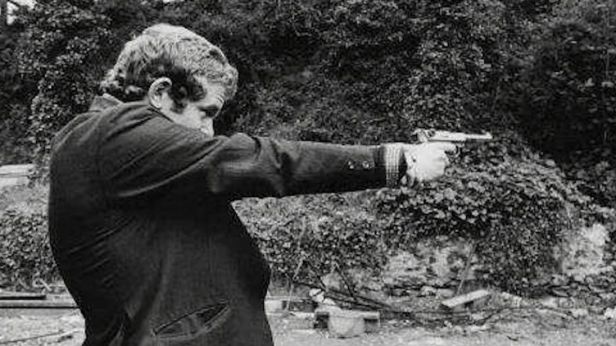
There were more moving parts to that escape than Brendan either told about or knew of.
The documentary did not detail Brendan’s 3 years of IRA activity in the Tyrone border area before the helicopter escape during which period the IRA’s “war” must have been largely about attacking not only British soldiers and members of the Royal Ulster Constabulary, but also members and former members of both the Ulster Defence Regiment and Royal Ulster Constabulary Reserve whether on the roads or at home in front of their families.
Obviously that kind of grinding and sectarian bloody recollection would not have been so audience attractive.
Also, Brendan did not highlight that in 1973 he and his Tyrone comrades – along with the IRA’s entire GHQ and Army Council – were totally dominated by one other Tyrone individual – Kevin Mallon – whose escape from Mountjoy Prison (only weeks after his arrest) was the priority of the helicopter escapade.

Mallon was the GHQ Director of Operations – he was the Main Man of the IRA’s Action Specials – and he was directing the entire England Bombing Campaign – a matter which the press at the time regularly reported – it was no secret.
This was the era of the IRA favouring journalists from The Irish Press Group and from The Guardian who regularly published detailed and accurate accounts of internal IRA matters.
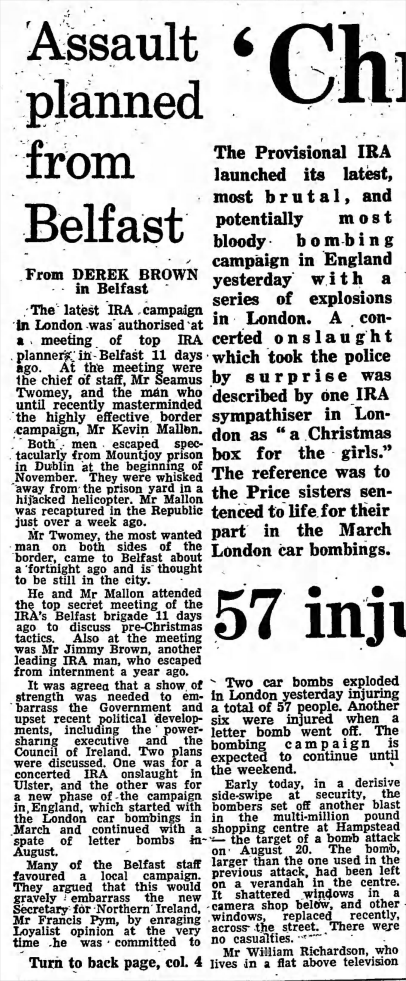
Mallon was dominating the IRA’s leadership by his devil-may-care attitude, bombast, threats and extremism – Mallon was not afraid to put a gun to the head of any person he was berating – he did this to me once after I had not murdered Albert Luykx for him – Albert Luykx was a former Nazi SS man living in Ireland (but sometimes traveling in Europe – where I met him in Brussels) who had been involved in the 1970 Arms Crisis.
Mallon believed that Luykx had betrayed the IRA.
Mallon had appointed ANOTHER TYRONE MAN as his deputy to replace him if he was arrested and removed from the action – this man was otherwise his car driver most of the time, Kevin McKenna, who would later rise to become Chief of Staff of the IRA for many years.
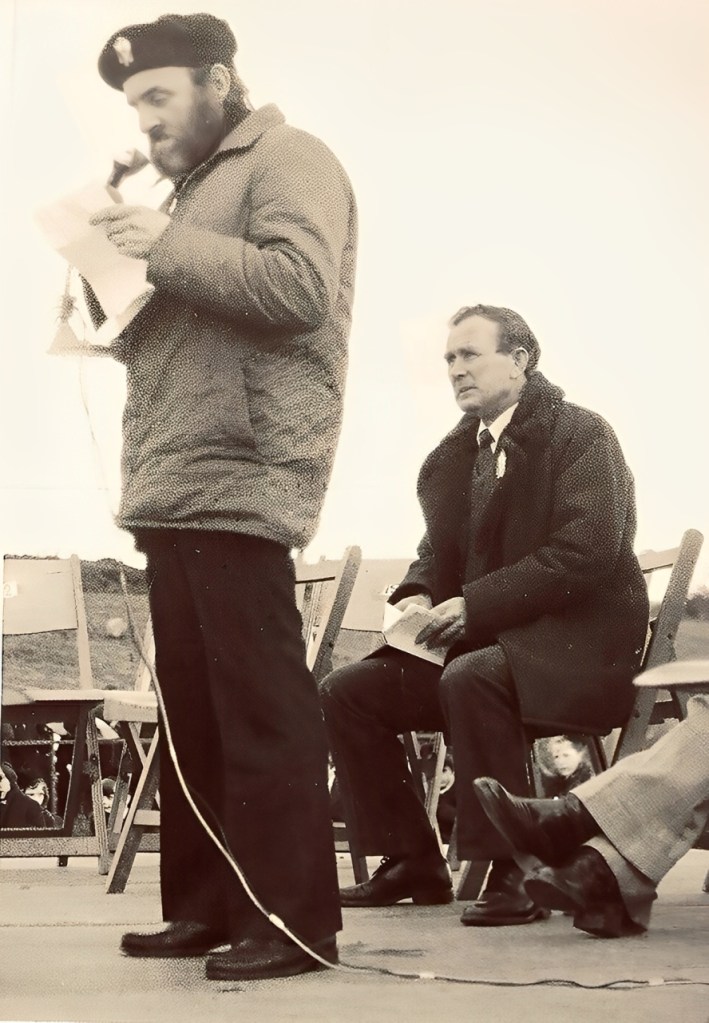
Mallon surrounded himself with Tyrone ‘operators’, male and female.
Mallon paid no heed to any rules of engagement or anything else – during one of his arrests, he called on Derry IRA volunteer Marian Coyle [who had been supplied to GHQ – as I was – by Martin McGuinness] to draw his weapon (which she was carrying) and shoot a detective member of An Garda Síochána – Marian did not do this and Mallon was re-arrested.
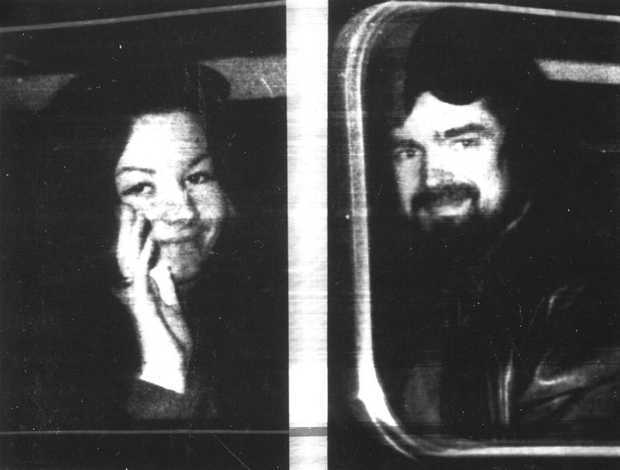
Mallon made his own rules at all times and his colleagues on the GHQ Staff, on the Army Council and his junior acolytes – McGuinness, Adams and others – never stood up to him regardless of what he did.
Mallon’s power was unlimited and unquestioned – there was no oversight of the vast monies that were swilling around the IRA’s leadership whether coming in from the United States or from bank robberies and ‘taxes’ on the building trade and other businesses or from wealthy donors, including Libyan dictator Colonel Muammar Gaddafi.
At one point McGuinness and I met Mallon – just after his helicopter escape and while he was on the run – in the country estate of an Irish millionaire.
Brendan Hughes expressed the hidden influence of no-rules Mallon through his treatment of the IRA’s Chief of Staff, Seamus Twomey, whom he told to stick whatever it was up his arse – and all of this in front of Kevin McKenna.
Hughes showed his disdain for the amount of an IRA offer to allow him to have a holiday in the United States to recharge – along with his wife and children – regarding £300 as too little.
I never heard of any lowly IRA volunteers getting foreign holidays for themselves and their families “to recharge” – I heard of such opportunities for IRA leaders, including their acquisition of sufficient finance to buy or build houses for themselves in the Republic of Ireland [while for many years these leaders never actually held down any job] – but it showed the expectations of Brendan Hughes under the lawless benediction of Kevin Mallon that he and his family should be funded with thousands of £££ for some United States R&R.
Brendan was not asked to tell BBC viewers how much of the robbed monies he was more usually allowed to take – or else just did take as his ‘cut’ – as his entitled payment for bank robbery services rendered to the IRA.
The fact is that during the heyday of Kevin Mallon’s reign there was no oversight of either his ‘jobs’ or of his spend of monies received into the IRA – and his favoured ‘operators’ could expect to be rewarded with such cash as the unfettered Mallon saw fit.
All of this, I might mention in passing, while active IRA volunteers ‘on the run’ in Northern Ireland were being given a weekly pittance by comparison – but they volunteered for that of course.
Liam Quinn – The Yank
Hughes mentioned an American who became involved in the helicopter escape.
A very few American citizens volunteered to join the IRA in the early 1970s.
Among them was a determined loner, William Joseph Quinn from San Francisco – such a loner that many in the IRA were concerned that he might be a CIA or FBI plant.
Almost immediately after the helicopter escape, I was at an informal meeting of the GHQ leadership – just before I was once again ordered to return to London to mount a second letter-bomb campaign over Christmas/New Year 1973/74 – when Quinn was being discussed.
The always paranoid IRA leaders were not certain that Quinn – who was tall, well made and looked every bit like an American GI – was not a spy sent to infiltrate the IRA’s senior ranks.
A decision was made to get rid of him to the England bombing campaign, and so he was later packed off to London to support the IRA unit which became known as ‘The Balcombe Street Siege’ four – a unit that was captured after a hostage and siege stand off which was utterly humiliating to the IRA.
Anyone involved in the England bombing campaign was entirely expendable – liable to capture, arrest or being shot dead within a relatively short time – remember ‘the Belfast 10’ seized mostly at Heathrow airport immediately after their attempt to bomb the Old Bailey and New Scotland Yard in March of ’73.
Anyway, GHQ got rid of Quinn in one fell swoop – and any CIA or FBI infiltration was going to end up either dead or in prison in England – or so they thought.
Quinn, the Murder of Constable Stephen Tibble & No Warning London Bombs
I remember one attempt to have a normal conversation with Quinn – he was living his own dream of IRA action and cut it short to want to know why there were not more IRA killings.
He wanted to see Action.
His level of expressed extremism had already sent up some red flags in the GHQ leadership.
While I was back in London for a second letter-bomb campaign that ended in early 1974, I found out that GHQ under Kevin McKenna had placed a unit in London that was going to engage in a bombing campaign without giving any telephone warnings.
I never met any members of that unit (the Balcombe Street Siege four), but I knew Quinn was also in London.
I had been the person who had in the summer of 1973 set up the IRA’s first recognised code word to enable the police to tell a real bomb warning from the hundreds of hoax bomb warnings that were occurring.
That code word or phrase was “Double X”.
The point to note is that when I was packed off to London to begin the first letter-bomb and small time bomb campaign there after the embarrassing arrest of the ‘Belfast 10’, Kevin Mallon had given no instructions whatsoever about any warnings.
I had made my own decision to create the warnings after discovering that on any day the police had no chance of determining my real bomb warnings from the multitude of hoax calls in the London area.
But not every IRA GHQ personality was in favour of giving bomb warnings in London, least of all Mallon and his sidekick No. 2 Kevin McKenna.
I decided that a no-warning London bombing campaign was not for me, so I left London and returned to Dublin for what turned out to be an argument with Kevin McKenna about the lack of bomb warnings.
Thinking that McKenna might be persuaded, I told him that London was filled with Irish people, American and other tourists from all countries – it wasn’t a singularly homogeneous BRIT target…
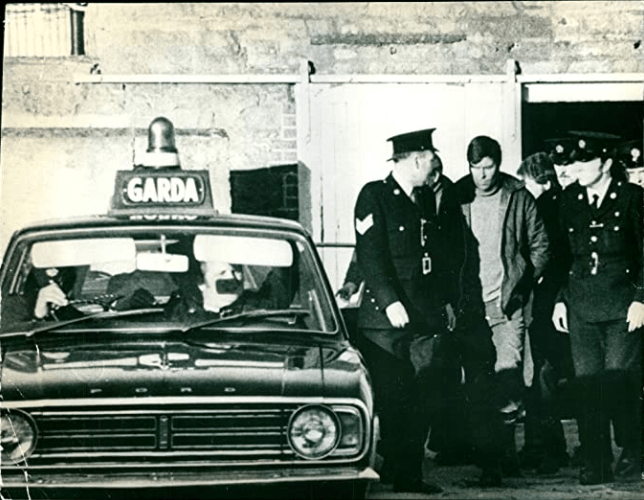
McKenna’s attitude was that it was the Brit Capital City, nevertheless, and all bets were off for the Brits now under his assumed role of GHQ Director of Operations since Mallon had been arrested yet again.
That was the end of my own London bombing campaign activity – brought about not by my arrest, but by a disagreement over bomb warnings or the lack of them.
Liam Quinn – the Yank – was ‘operating’ in London alongside the unit that later became known by its capture in the Balcombe Street Siege, but he wanted more ACTION.
Best to let Quinn’s 1984 appeal against extradition to the UK describe his murder of Constable Stephen Tibble:
The murder with which Quinn is charged took place on February 26, 1975.
On that day, Police Constables Adrian Blackledge and Leslie White were patrolling the West Kensington area of London on foot, looking for burglary suspects. Blackledge saw a man engaged in “suspicious” behavior, such as looking around and changing directions. Blackledge lost sight of the man but later, while White was on a lunch break, saw the suspect reappear from one of a number of houses on Fairholme Road.
Blackledge approached the man while he waited at a bus stop, identified himself as a police officer, and asked the man where he had been.
The suspect was unable to give Blackledge the address of the house he had emerged from and gave his name as William Rogers. The suspect said he would take Blackledge to the home he had visited, began to walk away, then ran.
A chase ensued, and other plainclothes police officers, including Temporary Detective Constable Derek Hugh Wilson, joined in.
Police Constable Stephen Tibble, who [was off duty] was on a motorcycle dressed in civilian clothes, caught up to the suspect, got off his motorcycle, and assumed a crouched position.
The suspect shot Tibble three times and ran, evading the other officers. Tibble died that afternoon.
On May 14, 1975, Constable Blackledge was taken to the Special Criminal Court in Dublin, where Quinn was appearing on the charge of being a member of the IRA. Blackledge pointed Quinn out to Rollo Watts of the Special Branch of New Scotland Yard and identified Quinn as the man who had shot Tibble.
On October 8, 1981, Watts was shown a photograph of Quinn taken in San Francisco on September 30, 1981, at the time of Quinn’s arrest by the FBI. Watts identified Quinn as the man that Blackledge had identified in Ireland six years earlier.
Police Constable Stephen Tibble was off duty and just happened to be passing by on a scooter when he saw the chase and decided, on a whim, to join in and try to apprehend a fugitive – with no idea that the man running from police was an armed IRA terrorist.
Tibble was only six months in the Metropolitan police and had recently married.
He was, of course, unarmed.

For his part, Quinn had no idea that Tibble was a police officer – he was just a civilian trying to impede his escape and he didn’t need to fire three shots into the chest of the young man in front of him – but he wanted to make his mark in the IRA’s London bombing campaign, and here was his chance – a chance to get a KILL.

But instead of staying on in London to continue the IRA’s campaign there, Quinn escaped back to the haven of the Republic of Ireland where he was almost immediately arrested and imprisoned for membership of the IRA and an assault.
Quinn’s furtive behaviour on a London street had not only caught the attention of police, but had cost the IRA a bomb factory and all the ‘gear’ and intel left in there.
The unanswered question is whether he made his own decision to get out of London – not usually within his gift as an IRA volunteer to decide when to come and go – or whether the IRA unit to which he had been attached decided that he was indeed a liability and wanted rid of him.
I believe the latter was the case.

The Irish authorities regarded Quinn’s murder of Police Constable Stephen Tibble as a political act and would not extradite Quinn back to the UK to face justice – it was only when he returned to San Francisco in 1981 to take up a job as a shop clerk that he was arrested and ultimately extradited back to the UK in 1986.
Hughes The Devious Bastard
In late 1973 when I had the argument with Kevin McKenna about No Warning Bombs in London, I was 18 years old and not very mature.
I think I was at that time the youngest of the IRA Volunteers ‘attached to GHQ’.
In spite of or perhaps because of my age, I had no fear of arguing that an IRA job or tactic was wrong – particularly the planting of bombs without warnings in the centre of London around civilians from many different countries.
Brendan Hughes expressed in the BBC program that he thought the IRA’s already known practice of “disappearing” murdered persons and their corpses was wrong – he didn’t agree with it, he said.
Hughes waited over 50 years to express this to anyone.
Yet at no point did Hughes – who was 26 years old in 1973 and no teenager – ever speak out against the IRA’s pratices he felt were wrong – disappearing persons and their corpses, murdering innocent Protestant civilians in sectarian attacks which the IRA often denied or pretended were the work of the make-believe “Catholic Action Force” – a name likely to make ALL Catholics targets in response.
Indeed, when in 1975 I was suspended in Crumlin Road Gaol for challenging the Belfast Brigade of the IRA about its secret sectarian murder campaign against innocent Protestant civilians – not a single other IRA Volunteer ever spoke out in support of me, either privately or publicly.
Not a single one of the prominent Tyrone IRA volunteers orbiting Kevin Mallon ever spoke out against anything that Mallon or the IRA were doing.

Although Brendan Hughes expressed in the BBC documentary series that he would never participate in any violence and questioned its productivity, in his privately printed biography [written by Douglas Dalby in a print run of 5,000 copies] he claimed the opposite – he would do the same again:
I don’t regret what happened to me. I would do the same again. I was defending my community. I regret the innocent lives lost but there is nothing I can say to lessen the pain of those left behind. I have also lost many comrades over the years … It was a dirty war.
Why didn’t the BBC highlight this rather obvious contradiction???
When a person smiles at the camera and appears to take some pleasure in describing himself as having been a “DEVIOUS BASTARD” not only to the targets and victims of his IRA activities, but also to the very IRA that armed him and licensed him to operate as a killer, bomber and bank robber – and that he later deserted the IRA and turned to bank robbery for personal gain – you have to be on your guard.
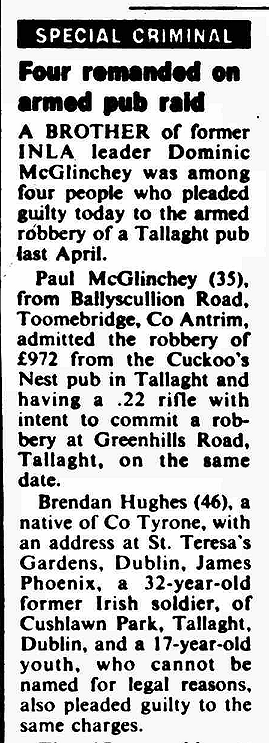
Hughes continued robbing banks until 1993 – two decades after his desertion of the IRA – when his final bank robbery [on behalf of the INLA’s “mad dog” Dominic McGlinchey] ended in his arrest and later conviction.
The amount of money he failed to rob from The Cuckoo’s Nest pub – a paltry £972.
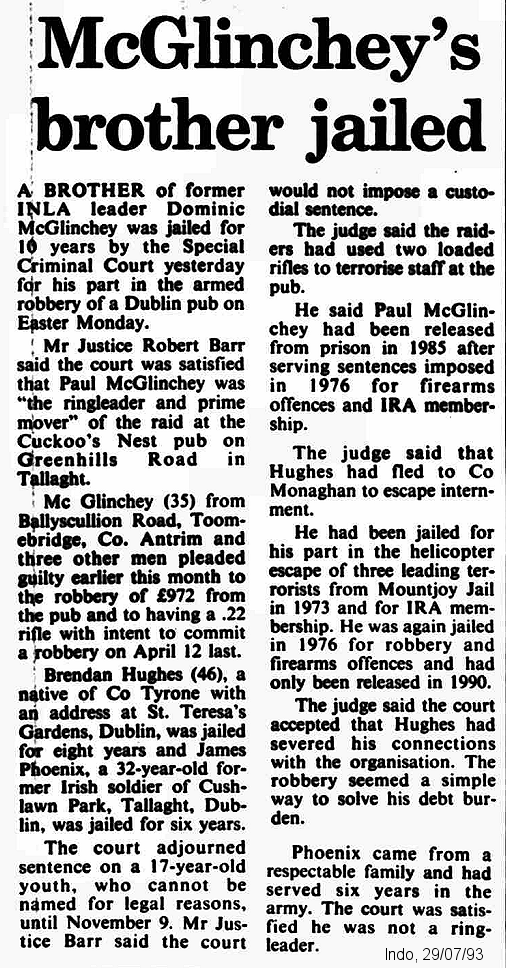
At what point did Hughes experience a change of heart?
Since he records that he would “do the same again“, can he ever really be viewed as someone who experienced a change of heart regarding violence?
 The Irish Peace Process