
Are Northern Ireland Loyalists entitled to object to the Irish language?
Decades of Irish nationalist objections to Irish language discrimination and fakery are nowadays very much downplayed.
Since the founding of the Irish Free State, Irish governments and related institutions have partially hacked away at the arbitrary “Irish language requirement” that discriminated against Irish citizens who could not speak Irish or who never wanted to speak Irish.
Not all Irish citizens are equal under Irish language jiggery-pokery – some are way more equal than others.
While Irish governments have pretended to foster the Irish language, there is no Irish language proficiency requirement for candidates for the Irish parliament, for the Irish senate or for those appointed to senior positions in Irish governments who make and unmake the rules that govern the rest.
Nor is there any Irish language requirement for those elected to or employed in local councils.

For a number of decades, there was an Irish language requirement for those wishing to be barristers or solicitors in the Republic of Ireland – however, this more powerful legal lobby got rid of the Irish language requirement without difficulty eventually in 2007.

The worst Irish language discrimination was practised against – and is still practised against – those wishing to become teachers in the Republic of Ireland – a body without the clout of barristers and solicitors.

Even when there were years of dire shortages of primary school teachers in Ireland, with many hundreds of “unqualified substitute teachers” filling in [I was one of these in 1993/94 while a postgrad], an Irish language proficiency requirement was (and still is) set against those wishing to be teachers.
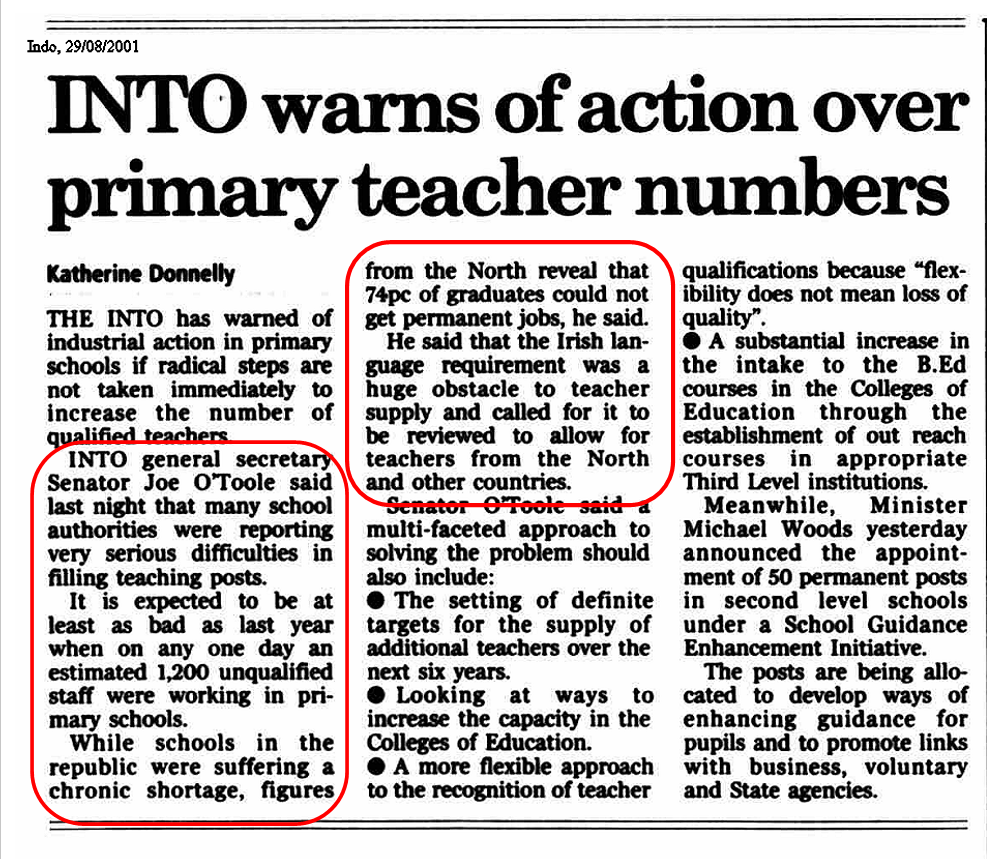
The teachers’ union – the Irish National Teachers Organisation (INTO) – as far back as 2001 was calling for the Irish language requirement – nay, impediment – to be dumped to allow qualified teachers from Northern Ireland (and elsewhere) to fill the many vacancies.
Highly qualified nationalist/Catholic teachers from Northern Ireland – who don’t speak Irish – were subject to Irish language discrimination.
In some cases, nationalist/Catholic teachers from Northern Ireland were hired and put to work, but later – sometimes within a 5 year period when they were supposed to pass an Irish language proficiency test – were effectively fired – after having been on 50% of the salary of their Irish-qualified colleagues – even in cases where there was NO IRISH LANGUAGE component to their jobs!

Michael Morgan, from Derry, who was hired to teach children with learning difficulties in Ballyshannon, Donegal – and who was on HALF PAY because his Northern Ireland qualification didn’t include Irish – was effectively fired because he, his wife and three children couldn’t live on his 50% salary.
In another case, three nationalist/Catholic sisters from Fermanagh, Aishlin, Venessa and Sinead Feely, were all second-class citizens/teachers because of the fakery of the Irish language requirement.

The INTO conference in 2004 heard that:
Primary teachers who have trained outside the Republic are required to sit the exam.
Teachers who do not succeed within five years run the risk of losing their jobs.
Twenty years later the same calls are still being made by teacher bodies for the ‘suspension’ [get real – for the DUMPING] of the Irish language requirement rule.

Primary school principals have called for the Irish language qualification requirement for teachers to be suspended to ease the “crisis” in teacher supply.
Under existing rules, all new primary teachers need to have a minimum of a H4 grade (60 to 69 per cent at higher level) in Irish in the Leaving Cert or an equivalent Irish diploma.
The Irish Primary Principals Network’s (IPPN) annual conference in Dublin heard that many schools are struggling to source substitute teachers to cover short-term absences.
“Recruiting surplus teachers from Northern Ireland is an attractive option, particularly for our border counties, as is recruiting teachers trained in other countries whose first language is English,” it said, in a statement.
The Irish language impediment was also preventing the headhunting of highly talented Irish emigrants who had excelled in their fields abroad, in one celebrated case a Mayo Clinic endocrinologist, Timothy O’Brien.
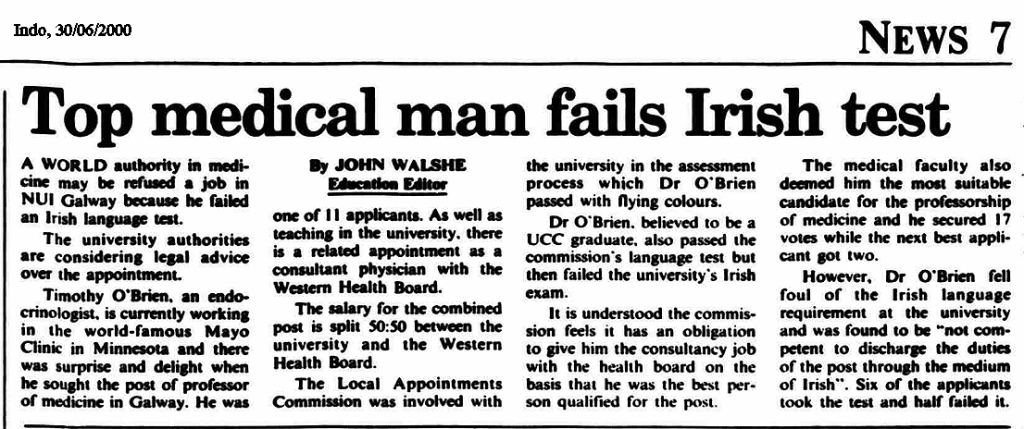
A world authority in medicine may be refused a job in NUI Galway because he failed an Irish language test.
The university authorities are considering legal advice over the appointment.
Timothy O’Brien, an endocrinologist, is currently working in the world famous Mayo Clinic in Minnesota and there was surprise and delight when he sought the post of professor of medicine in Galway. He was one of 11 applicants. As well as teaching in the university, there is a related appointment as a consultant physician with the Western Health Board.
The Local Appointments Commission was involved with the university in the assessment process which Dr O’Brien passed with flying colors.
Dr O’Brien, believed to be a UCC graduate, also passed the commission’s language test but then failed the university’s Irish exam.
It is understood the commission feels it has an obligation to give him the consultancy job with the health board on the basis that he was the best person qualified for the post.
The medical faculty also deemed him the most suitable candidate for the professorship of medicine and he secured 17 votes while the next best applicant got two.
However Dr O’Brien fell foul of the Irish language requirement at the university and was found to be “not competent to discharge the duties of the post through the medium of Irish”.
Six of the applicants took the test and half failed it.
This kind of discriminatory Irish language jiggery-pokery was being practised in the full knowledge that it would have been impossible to find a fluent Irish speaker in the Galway area who didn’t understand English and who would have refused Dr. O’Brien’s life-saving skills for his failure to speak the bare minimum of a dead language most of the country didn’t and couldn’t speak.

As the years passed since I studied Irish and won summer scholarships in my teens to the Rannafast ‘gaeltacht’ [Irish-speaking community in the West Donegal], the gaeltacht areas themselves were losing interest in the Irish language.
Not one of the 170 families with school-going children in a designated Gaeltacht area has managed to satisfy inspectors of the department of the Gaeltacht that it is Irish-speaking.
In fact, in the wider community of the Irish Republic, Irish was nothing more than an old Irish Nationalist Totem – and like Latin, a ‘dead’ language – about which few could speak honestly.

The facts behind all the Irish language fakery are obvious:
An EC report published this year reveals that two-thirds of Irish people between the ages of 15 and 24 cannot hold a simple conversation in another language.
Only the British with 70 p.c. in the same category, fared worse than ourselves.
How different from the situation in Luxembourg where 53 p.c. can hold a conversation in three languages.
As various other academic and governmental reports declared, this failure in most cases came after some students had had the benefit of Irish language schooling for up to 14 years! And still couldn’t hold a proficient conversation in Irish!

Even when an entire gaeltacht area is caught with its pants down with everybody speaking English AND NOBODY ABLE TO SPEAK ANY IRISH, there is still total denial about the dead-but-slightly-revived Irish language:
Tourists who wrote a letter to a national newspaper about their disappointment at the lack of Irish in dingle were just “unfortunate to not have encountered Irish speakers”, says a language planner.
The director of the Dingle-based group facilitating an Irish-language plan for the town insisted there is no shortage of speakers in the Gaeltacht town.
In a strong letter to The Irish Independent, John Leahy of Wilton Road, Cork, said that while on a reent trip to dingle, he and his wife “quickly discovered that few of anybody there speaks as Gaeilge [in Irish].
“We naively expected that, being in Dingle, in the Gaeltacht, the Irish language would be widely spoken throughout”, Mr Leahy said.
However, he claimed that none of the staff at the accommodation availed of by him and his wife could even speak basic Irish.
He said he was met with similar issues upon visiting businesses in the Gaeltacht town and that “nobody we met seemed embarrassed or apologetic, despite the town bieng festooned with business and street names, as well as directional signs in Irish”.
Entry to the Irish police force – An Garda Síochána – was bedevilled by an Irish language requirement until 2005 but the force’s inability to engage with “foreign nationals” living and working in Ireland highlighted the absurdity of this impediment, never mind the many Irish citizens who would have served with distinction but were prevented by the National Hypocrisy over the dead language.

While Irish is no longer a requirement for An Garda Síochána, the impediment – like a Zombie that won’t die – is liable to creep back in some form or other as Irish governments try to convince Brussels that there is a pulse in the corpse of the dead language.
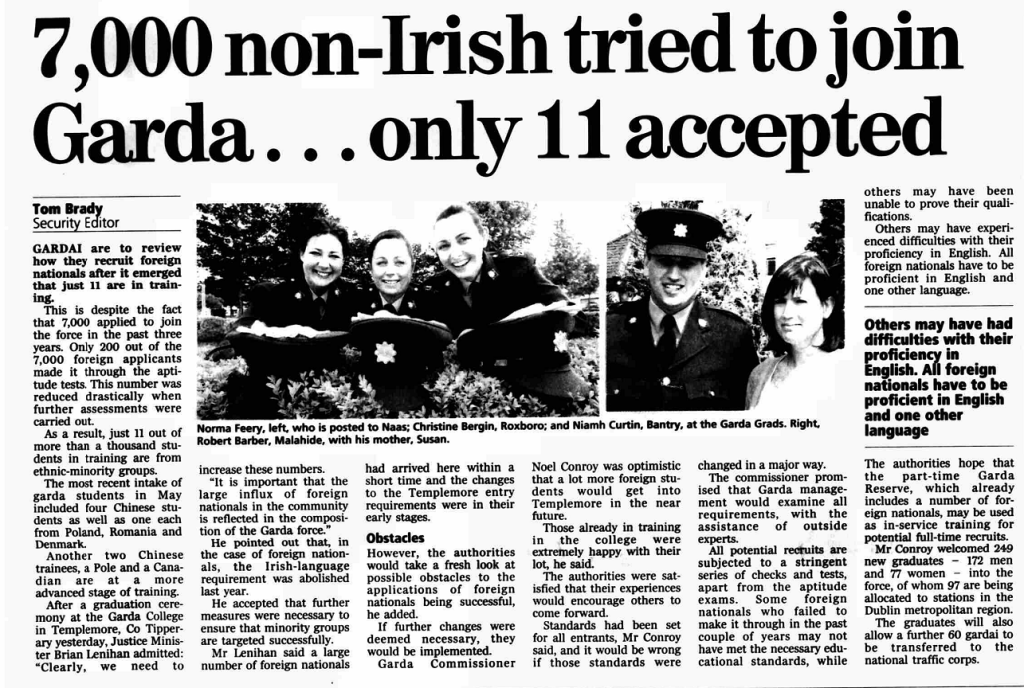
Note that Commissioner Drew Harris – good Northern Prod – was fortunately not made to utter the “cúpla focal” [few Irish words] to get his shekels.

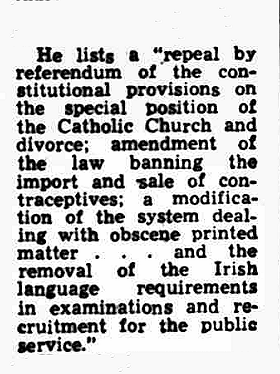
Garret Fitzgerald, writing in his book “Towards a New Ireland” in 1972, a full ten years before he became the Republic of Ireland’s 8th Taoiseach (prime minister), called for the Republic to make a number of fundamental changes, namely:
repeal by referendum of the constitutional provisions on the special position of the Catholic Church and divorce;
amendment of the law banning the import and sale of contraceptives;
a modification of the system dealing with obscene printed matter…
AND THE REMOVAL OF THE IRISH LANGUAGE REQUIREMENTS IN EXAMINATIONS AND RECRUITMENT FOR THE PUBLIC SERVICE.
It was only in 1973 that the Irish Civil Service dumped the Irish language requirement – an impediment that turned away many brilliant “non-cúpla focal” mathematicians, statisticians, sociologists et al – leaving the bloated Civil Service staffed with those who could offer a few words of Irish to the fewer citizens ever seeking to avail of the lingo.
Face it – the Irish Free State (to use Shinnerspeak) or the Irish Republic – is a hypocritical hole and the dead corpse of the Irish language is rotting somewere down in it.
As for Northern Ireland – the whiff of cordite, gelignite and murdered and bombed citizens – men, women and young children – still odorizes many of the unrepentant IRA zealots of Irish – while virtually all of the IRA and Sinn Féin Irish zealots couldn’t between them produce a room full of Irish speakers to save their skins…
Had the IRA movement ever had any love for the Irish language, they would have sought to distance their muderous fingerprints from any association with it – they who obviously weaponized the language in the continuing attempt to “break the [Orange/Protestant] bastards”…
Equally, if you truly loved the Irish language you would endeavour to keep it away from conflicted situations – from conflicted communities.
Are there not sufficient opportunities to learn Irish elsewhere, where there are no conflicts?

For a ‘commentator’ for hire such as Alex Kane to Tweet that he is not threatened by Irish or by the IRA-Glorifying GAA – this virtue-signalling is entirely empty of usefulness to the conflicted communities – but I suppose warmly greeted by the tumescent Irish nationalism that so promotes the dead language.
It would have been more useful if Alex had examined how the Irish language zealots have for decades injured their co-citizens.
And if he had expressed a view that the GAA should clean up its terrorist-glorifying act?
Alex – but you do make a secret of your Unionism – I see you more as Alliance party.
As for Doug Beattie’s Tweet in a similar vein – I greatly respect Doug as a man and as a soldier – but politician he is not – more of a Shakespearian Coriolanus.

A politician is supposed to have listening ears, particularly to those on the fringe – and he or she should be the Go-To person for those conflicted.
The SDLP for 30 years were the Go-To persons for IRA terrorists who were murdering and bombing and look what John Hume transformed them into by listening and engaging!
Shouting at and belittling those of conflicted views only pushes them to the margin – and this serves no-one.
So, a little less empty virtue-signalling on Twitter and a little more listening and engaging with the honest fringes in the Unionist/Loyalist community – I mean, Unionists have been (and still are) more than willing to sit with and treat with and engage with convicted IRA bombers/gunmen/gunwomen/comrades of FARC coke-producers in Stormont during the past 20 years…
I mean – what’s more awful about Loyalists?
 The Irish Peace Process