

In October 2021, Michael McDowell revealed in an Irish Times Opinion column that some [approximate, unspecified] twenty years earlier:
In this [Irish] State, a de facto moratorium on investigation and prosecution of IRA members (other than those described as dissidents) came into operation.
This was demanded by [IRA terrorist leaders] Gerry Adams and Martin McGuinness, the leaders of Sinn Féin at the time.
And it was conceded.
McDowell’s deliberate use of the passive voice expressions – “came into operation” and “was conceded…” – without identifying any actors – appeared to distance himself from the concession, from the decisions made leading to the secret pardon.
He appeared to dissent from the secret grant of amnesty – using a formula of words that obfuscated what was in reality an amnesty:
a de facto moratorium on investigation and prosecution
McDowell was extra careful with his chosen words – he was not merely a barrister during the period of the secretive grant of an amnesty to IRA terrorists, he was Ireland’s Attorney General (July 1999 – June 2002), later Ireland’s Minister for Justice, Equality and Law Reform (June 2002 – June 2007) and finally Ireland’s Tánaiste – Deputy Prime Minister (September 2006 – June 2007).

Even when McDowell admitted to having been a member of the Irish government that finagled the secret amnesty for IRA terrorists, he once more appeared to distance himself from it:
But the Irish government of which I was a member took the decision that further investigation and prosecution by An Garda Síochána of such historic offences was no longer warranted or justified by reason of the greater interest in ending the Provisional [IRA] campaign and all other political violence in Northern Ireland.
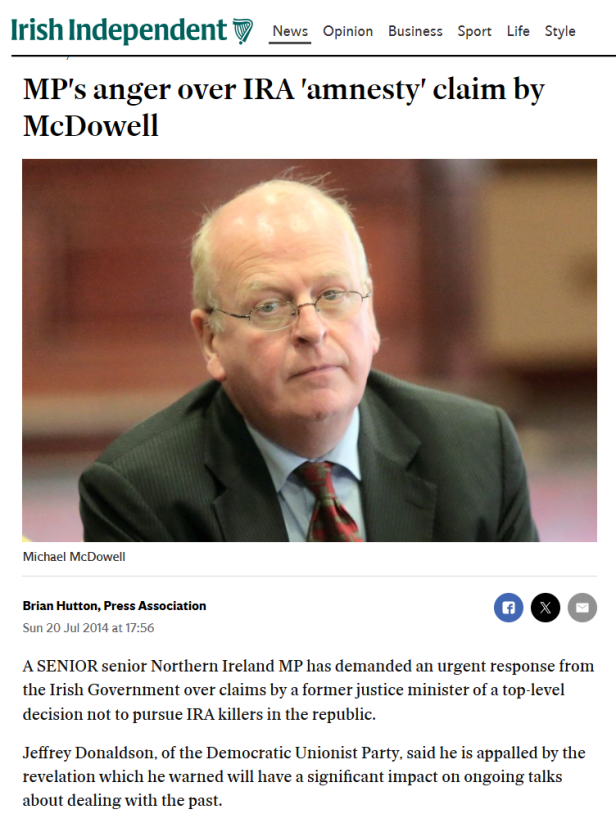
Instead of highlighting McDowell’s own participation in the secret grant of amnesty, the phrase “of which I was a member” implied that a greater collective government decision brought this about, that this all happened without his knowledge and nobody informed him until after the event – rendering him speechless about it for some 20 years.
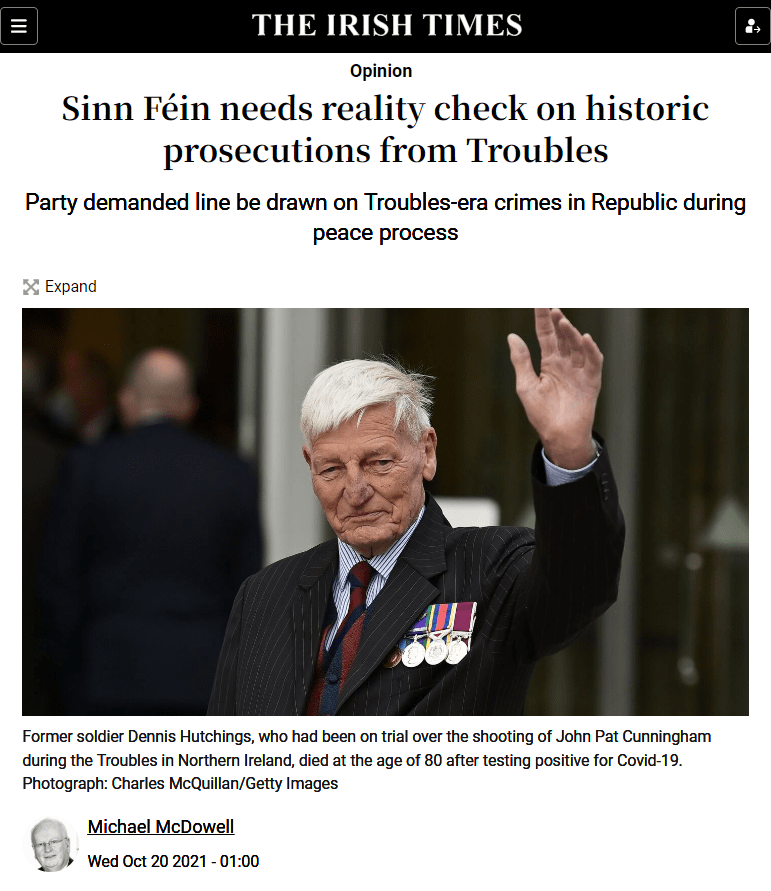
Notice that McDowell’s Irish Times secret amnesty revelation – coming some 20 years after the event – didn’t confirm when the secret grant of amnesty to IRA terrorists actually began.
Why didn’t McDowell – the late-born, conscience-stricken whistleblower – tell the lumpen proletariat when the secret amnesty was enacted?
And who precisely enacted it?
And if any members of the collective government dissented?
If you want to put on the sackcloth and ashes of a very belated Whistleblower, you have to serve up the details.
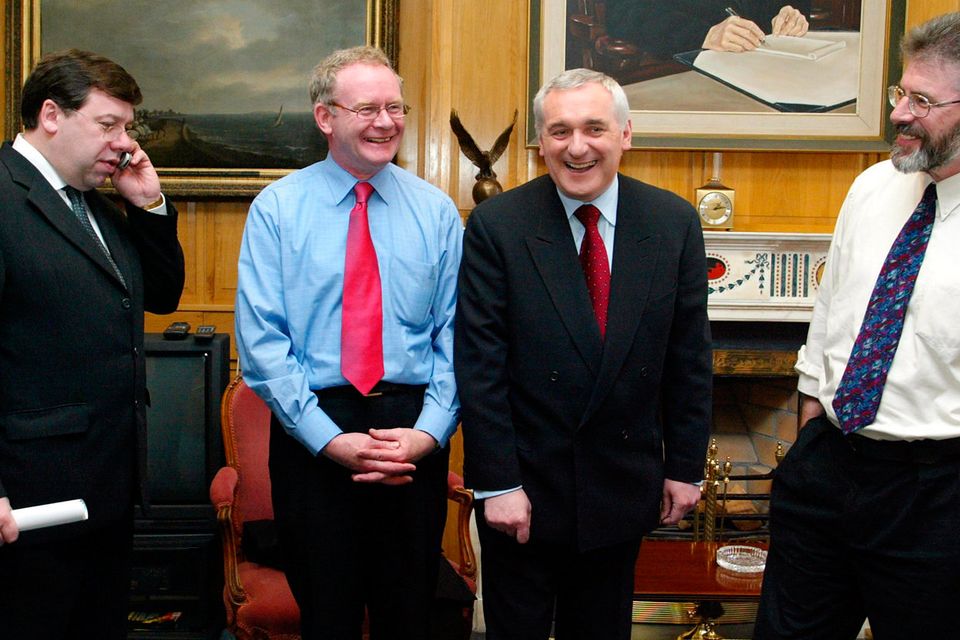
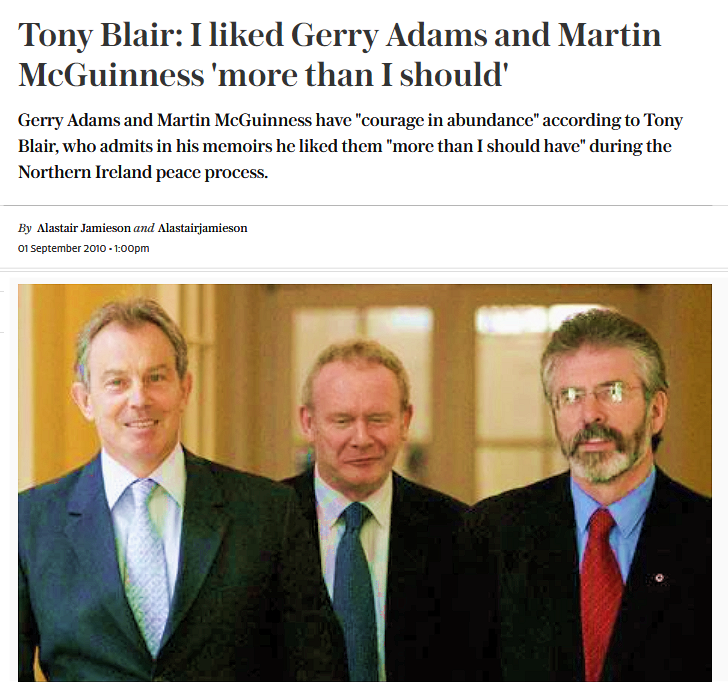
McDowell was a member of the Irish government between 1999 and 2007, but we know that it was the Irish Fianna Fáil government of Bertie Ahern in 1999 that begged Tony Blair’s British government to grant an amnesty to IRA terrorists who were still ‘on the run’ from both British and Irish justice.
We know this much because Bertie Ahern’s letter to Tony Blair has been in the public domain for some years:
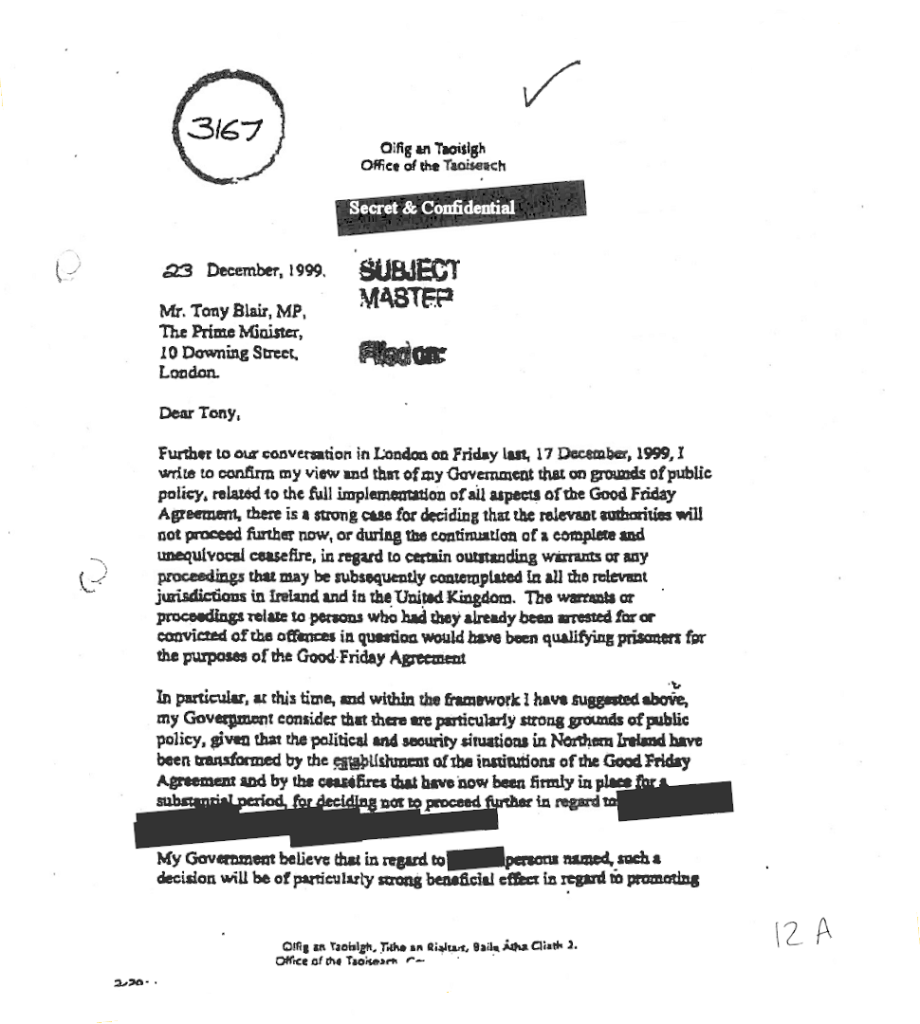
I reproduce copies of Ahern’s Amnesty-begging letter to Tony Blair for the record.
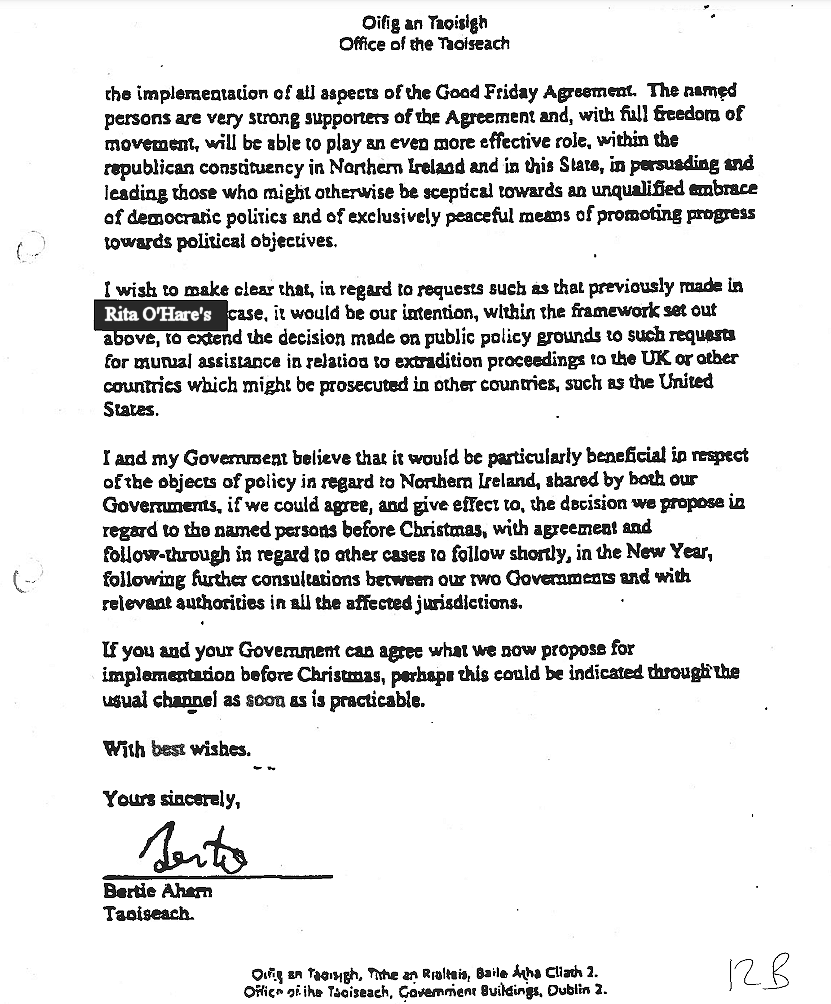
So one year after The Belfast Agreement was signed, the Irish government of Bertie Ahern undertook to enact a SECRET amnesty for IRA terrorists who were ‘on the run’ from both Irish and British justice for offences such as murders and bombings – SECRET from the public – and SECRET from the very innocent Victims of IRA terrorism.
I write to confirm my view and that of my Government that on grounds of public policy, related to the full implementation of all aspects of the Good Friday Agreement, there is a strong case for deciding that the relevant authorities will not proceed further now, or during the continuation of a complete and unequivocal ceasefire, in regard to certain outstanding warrants or any proceedings that may be subsequently contemplated in all the relevant jurisdictions in Ireland and in the UK.
In particular, at this time, and within the framework I have suggested above, my Government consider that there are particularly strong grounds of public policy, given that the political and security situations in Northern Ireland have been transformed by the establishment of the institutions of the Good Friday Agreement and by the ceasefires that have now been firmly in place for a substantial period, for deciding not to proceed further.
Such a decision will be of particularly strong beneficial effect in regard to promoting the implementation of all aspects of the Good Friday Agreement.
If you and your Government can agree what we now propose for implementation before Christmas, perhaps this could be indicated through the usual channel as soon as practicable.
And Ahern announced this to Tony Blair and begged him to also begin to put in place an “administrative” amnesty – one that did not require legislation or notification to either the Irish or British parliaments, least of all to the peoples of Ireland or Britain – least of all to innocent victims of the IRA.
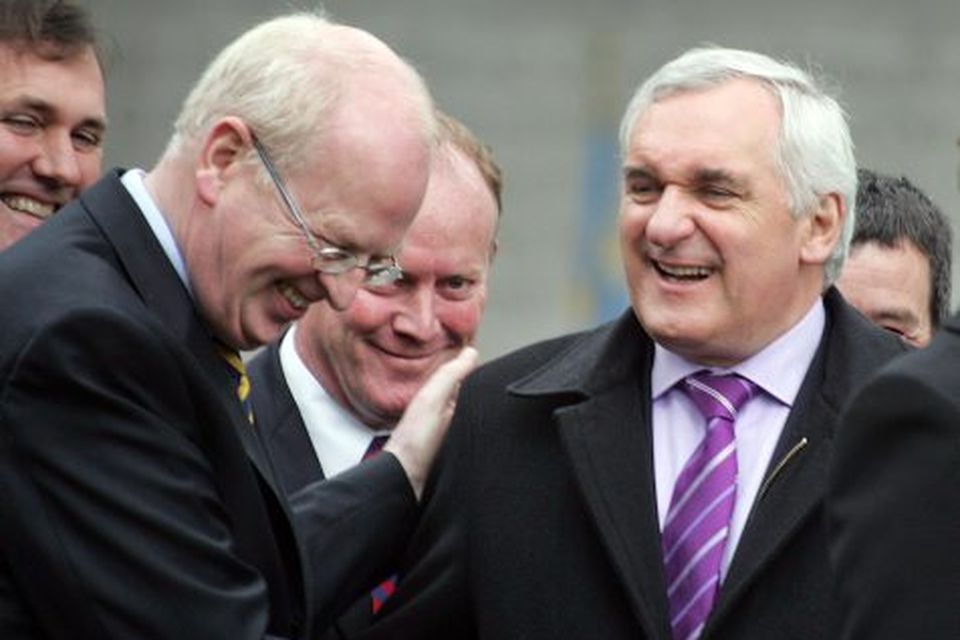
For a secret “administrative” amnesty to get off the ground, Irish premier Bertie Ahern needed to secure the backing of the country’s somewhat independent Attorney General [who happened to be Michael McDowell], the country’s totally independent Director of Public Prosecutions [then James Hamilton], and Ireland’s Garda/Police Commissioner [then Patrick Byrne].
In Ireland, the Attorney General, the Director of Public Prosecutions and the Garda/Police Commissioner are ALL appointed by the Government – and the Attorney General is NOT required to be independent of the government – so Ireland’s Taoiseach/Prime Minister Bertie Ahern basically had all three of these appointees by the balls.
When you have them by the balls, their hearts and minds will follow…
Britain’s Attorney General – although appointed by the government – is required to be independent of government and/or party political influence.
“The requirement for the Attorney General to act in the public interest and independently of political considerations is rooted in the UK’s constitutional framework, professional legal standards, and specific statutory duties.”
When Tony Blair later sought to pressure Britain’s Attorney General [Lord Williams of Mostyn] to get him on board the secret ‘administrative’ amnesty for IRA terrorists – specifically to drop charges against leading IRA terrorists such as Rita O’Hare [aka Marguerite O’Hare] – Britain’s Attorney General told him – in the nicest possible way – to Fuck Off and warned Blair that if he proceeded with the secretive amnesty proposal, he – the Attorney General – would inform parliament and also the general public.
Lord Williams also declared that the amnesty was not in the public interest and would be “immeasurably damaging to the administration of justice in Northern Ireland” [p.3 letter].
The secret amnesty was a betrayal of innocent victims of IRA terrorist Human Rights atrocities and would have the effect of burying all traces of the IRA’s atrocious Human Rights record as it donned Sinn Féin costumery and presented itself, newly deodorized and perfumed, to the misled electorate.

Lord Williams educates Tony Blair, letter page 1 (above).
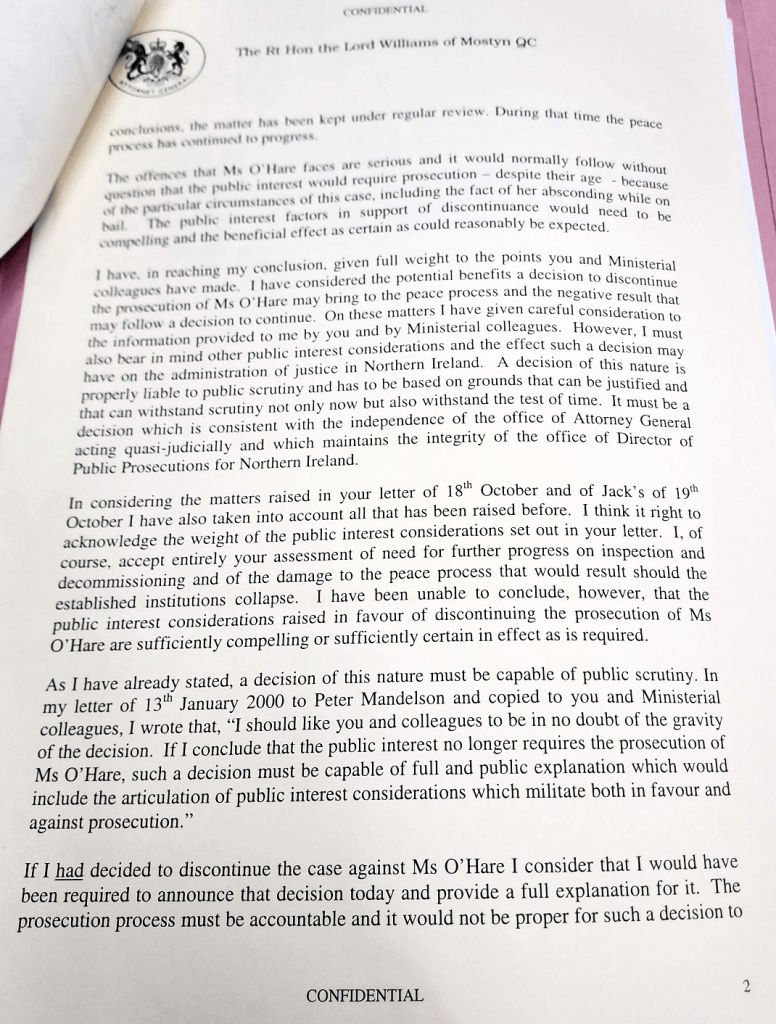
Lord Williams declares that if he had gotten on board Tony Blair’s secret amnesty train, he would have had a duty to go public about it, letter page 2 (above).
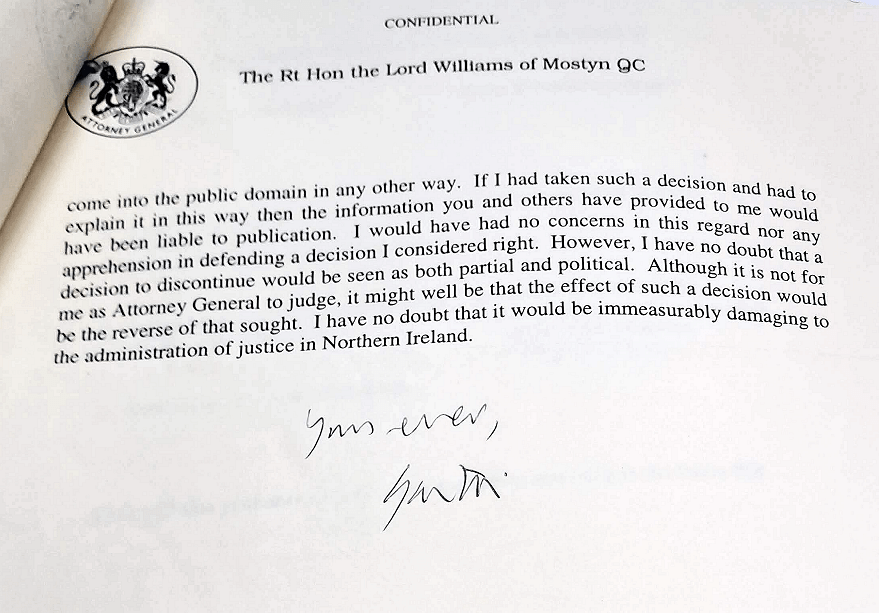
Lord Williams, Britain’s Attorney General, refuses Tony Blair’s secret amnesty deal, letter page 3 (above).
However, in the Irish state, the Government of the Day – in the person of Ireland’s most corrupt Fianna Fáil Taoiseach/Prime Minister Bertie Ahern – stated that it was going to proceed with the secret amnesty and was going to call on not only Britain but also the United States government to quietly drop all outstanding warrants, charges and extradition proceedings relating to on-the-run terrorists of the IRA.
Ireland’s Attorney General does not have the same degree of independence as Britain’s Attorney General:
“In Ireland, the Attorney General is not entirely independent of the government, but holds a somewhat unique and complex role. The Attorney General is the chief legal adviser to the government, which means they are appointed by the Taoiseach (the Prime Minister) and are expected to provide legal advice to the government on a wide range of issues. However, their independence is crucial when it comes to legal opinions and advice, particularly on matters of constitutionality.”
But Michael McDowell – who was Bertie Ahern’s Attorney General when Ahern sought the Irish/British/US Amnesty grant – expressed no opposition to Ahern’s desire to secretly whitewash the IRA’s appalling record of terrorist Human Rights atrocities, allowing hundreds of offences of murder, abduction, torture and bombing to be quietly hidden.
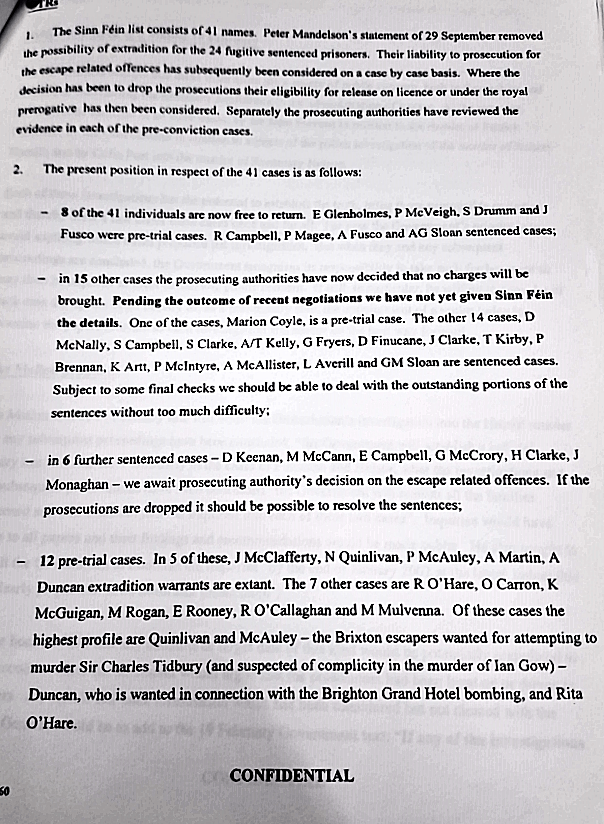
The bloody terrorist IRA-Sinn Féin entity was being granted a free Whitewash of its record of Human Rights atrocities and the free Disappearance of its prosecutable crimes of murders and bombings.
We know McDowell was a willing participant in Ahern’s secret betrayal of victims of IRA terrorist atrocities because McDowell – as Ireland’s Attorney General – wrote a letter [the year following Ahern’s letter to Tony Blair] to Britain’s Attorney General begging to know if the latter had quietly quashed outstanding extradition warrants for wanted IRA terrorists.
A copy of McDowell’s begging letter has been in the public domain for some years.
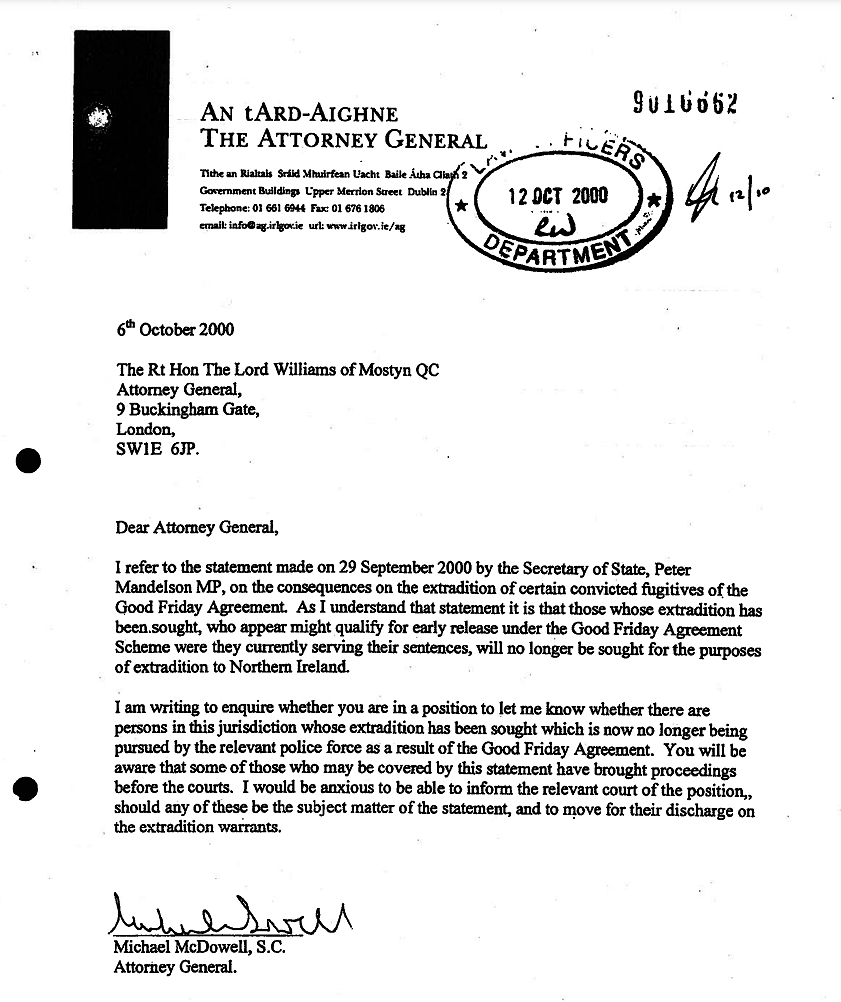
Not alone was Ireland’s Attorney General – Michael McDowell – actively participating in Bertie Ahern’s secret grant of Amnesty to wanted and on-the-run IRA terrorists, he was actively offering unsolicited advice to Britain’s Attorney General to the effect that Britain should grant the Royal Prerogative of Mercy to the IRA’s wanted on-the-runs…
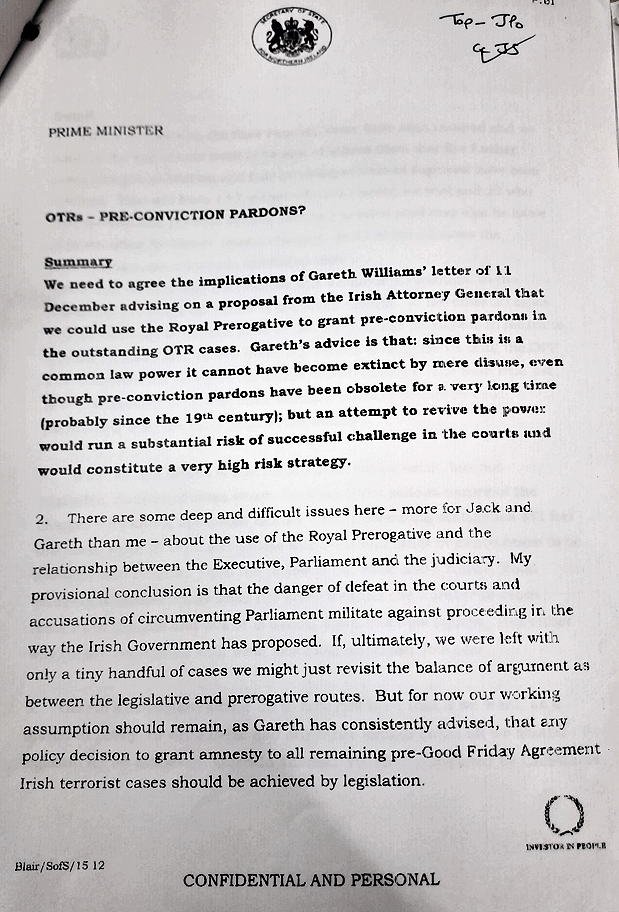
It was no part of an Irish Attorney General’s remit to offer legal advice to The Brits – but McDowell could not contain his perceived legal brilliance within Ireland’s set limits.
It is abundantly clear that McDowell cannot belatedly don the wig and gown of a Whistleblower revealing after two decades to a somnolent Ireland that a dirty amnesty deal was done with murderous IRA terrorists while he was a kind of mournful moral refusenik or ethical dissenter.
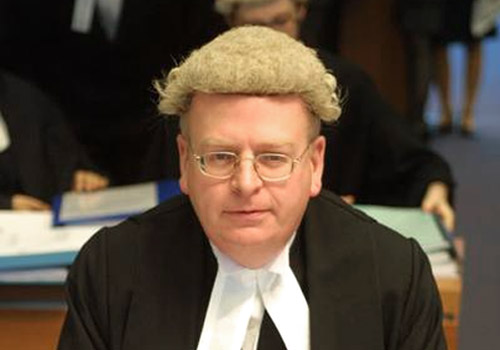
McDowell was right in there at the heart of it with his fingerprints all over the dirty deal.
Justice in NI was circumscribed legislatively and administratively during the the 1998 Belfast Agreement and its implementation by a further series of amnesties:
(1) immunities (called an amnesty in law) regarding terrorist weapons, from 1997 to 2013;
(2) The Northern Ireland (Sentences) Act 1998 with early release of all terrorist prisoners after two years served;
(3) The requests by Bertie Ahern and Michael McDowell for the UK to discontinue current (and future) extradition proceedings, acceded to by Tony Blair and Peter Mandelson in 1999-2000.
McDowell, writing later, painted himself as the only Hard Man in the negotiations/concessions to the IRA’s Army Council:
As minister for justice, I had to take a hard stance against any backsliding on the issue of decommissioning.
I warned against the tolerance of even a lightly armed defensive group of Provo members, which I dubbed a proposal for a political “Praetorian guard”. It was absolutely nonnegotiable as far as I was concerned that the only weapons on this island would be legally held weapons and that the only armed security services would be the Garda Síochána and PSNI.
When Gen John De Chastelaine reported that he had witnessed the decommissioning of the Provo arsenal, his report recited the statement by the IRA representative that this decommissioning included all the weapons and explosives in the possession of the IRA.
While that statement could not be totally verified, it amounted to a statement and undertaking by the IRA that it had decommissioned and no longer possessed any arms or explosives. Absolute proof that nothing was held back was illusory. But any subsequent proof that total decommissioning had not taken place was a political sword of Damocles hanging over the head of the Provisional movement.
In relation to criminality and the rule of law, I had to resist an attempt to create a parallel system under Provo control under the veil of Community Restorative Justice Committees. I had to take a hard stance on the Northern Bank robbery, the Makro robbery and extensive Provo-directed organised crime in the Republic. The same stance had to be taken against knee-cappings and punishment-shooting torture regularly carried out by the Provos.
I was not willing to go along with the childish political charade that Adams, Martin McGuinness and Martin Ferris were not members and in control of the Army Council.
Nor was I willing to see them as interlocutors with unseen “hard men” when the intelligence available to me made it clear they were the hard men.
In this approach, I was hugely supported by the US political envoy, Mitchell Reiss.
McDowell continued that the IRA’s illegal, criminal multi-million €/£/$ War Chest would have to be dealt with:
Finally, money-laundering is a crime.
Nobody has yet been implicated in the control or disposal of the Provo accumulated war chest of hundreds of millions of euro and pounds. That remains a challenge for the Criminal Assets Bureau, the Northern Ireland Assets Recovery Agency and the security services – a challenge made no easier by the involvement of not a few household names as fronts for the laundering of those monies.
In the end, ‘hard man’ McDowell and his democratic colleagues not only secretly whitewashed the IRA’s unprosecuted bloody Human Rights’ atrocities from the historical record – allowing the IRA entity to don the clothing of a recently democratised para-Sinn Féin and appear before the electorate deodorized and laundered – they apparently never set in train the pursuit of the IRA’s criminal War Chest which he – McDowell – had himself highlighted…

Nor did McDowell ever explain his reference to:
the involvement of not a few household names as fronts for the laundering of those monies
McDowell was plainly stating that he [and his government colleagues] knew – presumably based on Intelligence information – the identities of “household names” who were fronting the IRA’s illegal criminal terrorist financial empire.
But – in line with all McDowell’s other blether – neither he nor his secret-amnesty granting confederates ever managed to effect either the prosecution or the unmasking of the IRA terrorist financiers.
Bertie Ahern’s secret grant of amnesty to the IRA obviously went on to include the IRA’s War Chest.
The 2021 press reportage following McDowell’s Irish Times revelation failed to accurately situate McDowell at the heart of the secretive and undemocratic deal with the IRA’s Army Council.
McDowell made no secret of his total support for the secretive grant of amnesty to not only the IRA’s On-the-Runs but also to the IRA’s Army Council leadership which had directed terrorist bombings and murders for three decades. He wrote:
When it came to the issue of whether the IRA should take some steps of formal disbandment, the governments had a clear political calculus.
Precisely because of the IRA’s “creation myth” ideology, [The IRA Bible, otherwise known as the Little Green Book, asserts that the IRA’s Army Council was, in 1938, formally and in writing handed over the role of the “Government of the Irish Republic”] the choice was between an IRA that became an inert, unarmed and withering husk or an open-goal opportunity for dissidents to re-form an Army Council as the legitimate heir of the body which had been “treacherously” wound up.
Past splits and schisms in the IRA showed only too clearly that the IRA could more easily metastasise rather than wind itself up. That was seen, and I think rightly, as being the greater evil to be avoided.
The governments took the view that an inert, freeze-dried husk of the IRA was preferable to passing the ideological torch to the dissidents. The analogy that was used at the time was that it would become like the “Old IRA”, a harmless grouping. That is what Adams warranted would be involved in the IRA “going away”.
So McDowell – while protesting about the IRA Army Council’s War Chest – believed that the IRA Army Council should be allowed to wither on the War Chest rather than be ‘wound up’ and suffer prosecution for 1,700 murders and innumerable bombings.
McDowell operates a blog to record and publicise his various political activities and writings – and these highlight some of his many contradictions.
In 2021, McDowell published on his blog a brief, blunt argument explaining his support for – basically – an Amnesty for all sides involved in the Northern Ireland Troubles – whether paramilitaries or government security forces – entitled “When do we accept awful things cannot be undone?“
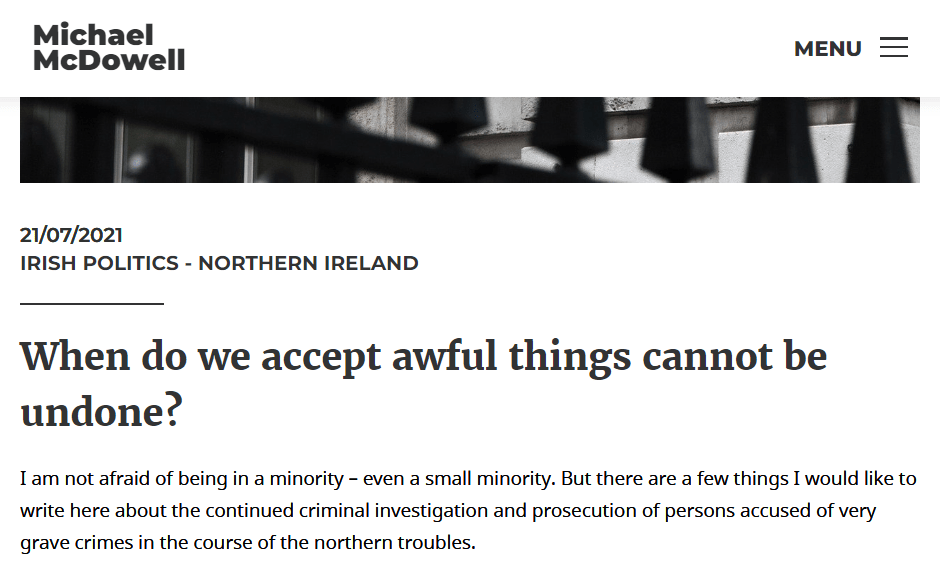
Seeing no difference between paramilitaries and government security forces – and certain that these will never pony up any admissions even in any form of Truth & Reconciliation commission – and following on from the fact that there have been effectively No Prosecutions of terrorist offences since 1998 in either jurisdiction – the Greater Good demands that victims of terrorism should bend over and take the Amnesty as an enema and we should all move on into a Better Future mindful that there have been other amnesties in the past.
As attorney general and Minister for Justice, I was – and am – aware that you could easily accuse the Irish State of denying justice to the victims of crimes committed on both sides of the border, remembering that most serious crimes in either part of the island were liable to prosecution under the Criminal Law Jurisdiction Act 1976.
Does this mean that we consciously violated the constitutional rights of victims and their relatives in pursuit of some unworthy expedient? Was our approach morally inferior to the de facto British legal limitation to minor punishment of one or two years’ in prison for similar grave crimes in Northern Ireland?
For my part, I think not. There is a world of realpolitik in which statesmanship sometimes requires that a line be drawn over past events – including atrocities – in pursuit of the greater good.
You witness the decline of a once greater mind…
Apparently, the Greater Good in McDowell’s argument does not include how Ireland upholds its international obligations with regard to Human Rights and the investigation and prosecution of those who committed grave Human Rights atrocities – including abduction, torture, extra-judicial “executions” with the disappearance of corpses of victims on an organised scale over three decades, the enlistment by the IRA of many “child soldiers” in Northern Ireland and their involvement in acts of terrorism, the regular repeated practice for 30 years of mass-casualty anti-civilian city centre bombings across Northern Ireland and Britain…

McDowell’s Greater Good involves turning a blind eye to the accumulation of a vast financial War Chest by acknowledged IRA terrorists who had initial support from the Libyan dictator and more recently from FARC, the world’s wealthiest narco-terrorists in Colombia – never mind the bank robberies (where Irish police were shot and killed), kidnappings for ransom (where Irish police and soldiers were shot and killed) and countless intimidations of builders and business people to pay “tax” to the IRA…
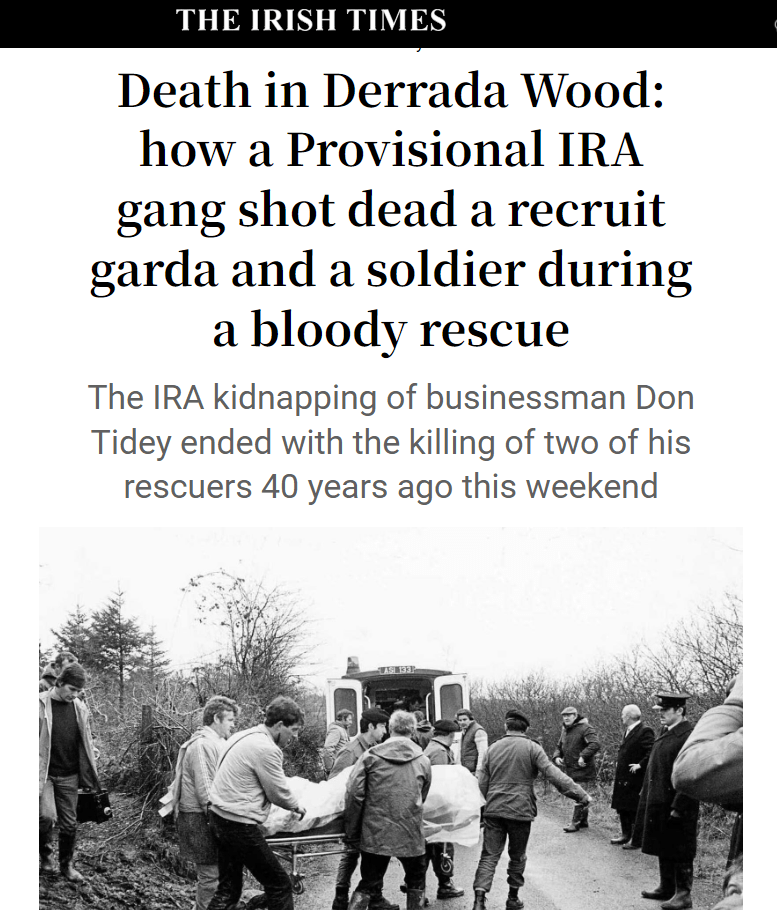
Is our Good all the Greater when we say to Tom Oliver, Terence McKeever, Brian Stack, Patrick Kelly or to Gary Sheehan – never mind to Patsy Gillespie or Jean McConville or Joanne Mathers and the countless other victims of callous IRA murders – our Contract with You – that our State would always seek to investigate and prosecute those who murdered all of you – for our Greater Comfort and Ease and Good We Are Going To Betray You by entering into a lazy accommodation with and amnesty for those who murdered you…
We forget the contract that binds all citizens to the State and to its laws and norms – and we forget the State’s duty to those who bind themselves to it – we are going to forget your murders and accommodate your murderers in the name of Good – of a Greater Good…
Never mind any arguments relating to Just Punishment and Deterrence…
No preconditions were set before the early release of IRA prisoners from their prison sentences – that they might have to make admissions about their murders and bombings – that they might have to tell where ‘the Disappeared’ were secretly buried – that they might have to turn over the IRA’s War Chest – no – there were no effective preconditions set before the IRA’s Army Council as its leaders laughed and joked with the British and Irish prime ministers…
Spanish Judge Prosecutes ETA’s Army Council, July 2024
And yet Spanish governments saw off ETA’s cessation of terrorism and later disbandment without any such accommodation with terrorist leaders – in fact, only last month – July 2024 – Spanish judges proceeded with the prosecution not only of the ETA gunmen involved in a 1997 murder, but also of ETA’s top leadership for its direction of that murder.
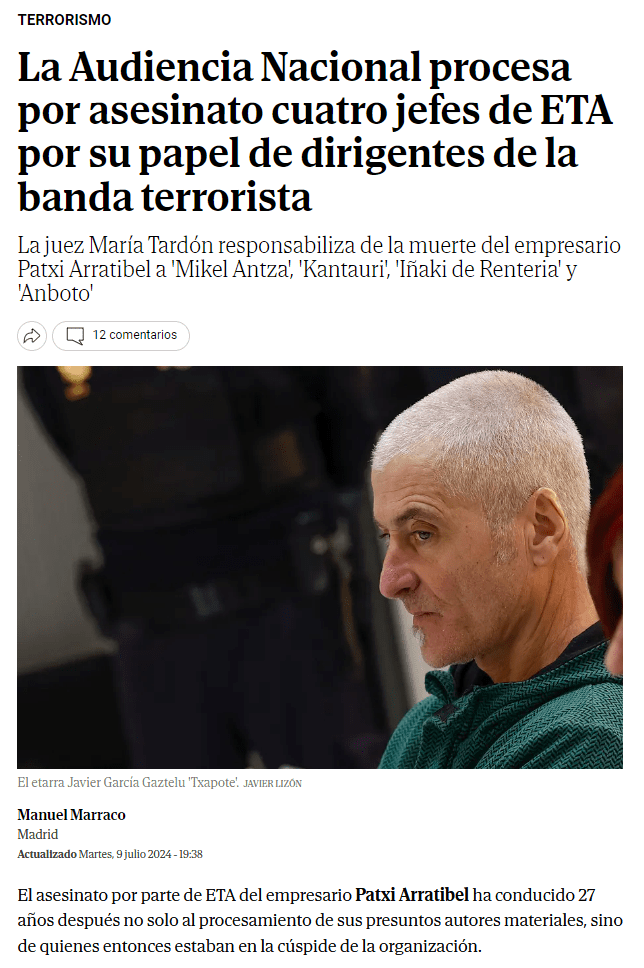
Translation of the El Mundo news article below:
The National Court is prosecuting four ETA leaders for murder for their role as leaders of the terrorist group
Judge María Tardón holds ‘Mikel Antza’, ‘Kantauri’, ‘Iñaki de Renteria’ and ‘Anboto’ responsible for the death of businessman Patxi Arratibel.
The murder of businessman Patxi Arratibel by ETA has led 27 years later not only to the prosecution of the alleged perpetrators, but also of those who were at the top of the organisation at the time.
This was decided by the National Court judge María Tardón, who on Tuesday indicted Javier García Gaztelu, ‘Txapote’ , and Irantzu Gallastegui, ‘Amaia’ , as directly responsible for the murder by means of a shot to the back of the head that occurred in February 1997 in Tolosa (Guipúcoa). But also the four top leaders of ETA at that time: Jose Javier Arizcuren Ruiz, ‘Kantauri’ ; Miguel Albisu Iriarte, ‘Mikel Antza’ ; Ignacio Miguel Gracia Arregui, ‘Iñaki de Rentería’ , and Soledad Iparraguirre, ‘Anboto’.
The judge explains in her ruling that all of them were part of the Executive Committee of ETA during the period in which the murder of the businessman was decided, planned and carried out, carried out by the Donosti commando , which at that time included Txapote and Amaia .
The decision represents a further step in the victims’ attempt to hold ETA leaders accountable for the murders committed under their command. Judge Manuel García-Castellón recently did so with the kidnapping and murder of Miguel Ángel Blanco .
In making her decision, Judge Tardón has taken into account the testimony of two repentant ETA members, declared protected witnesses. In the National Court, they declared that on the dates when Arratibel’s murder took place, the ETA leadership was planning “selective assassinations, both in the political and business worlds.”
Spain’s leading newspaper, El Pais, ran the story also:
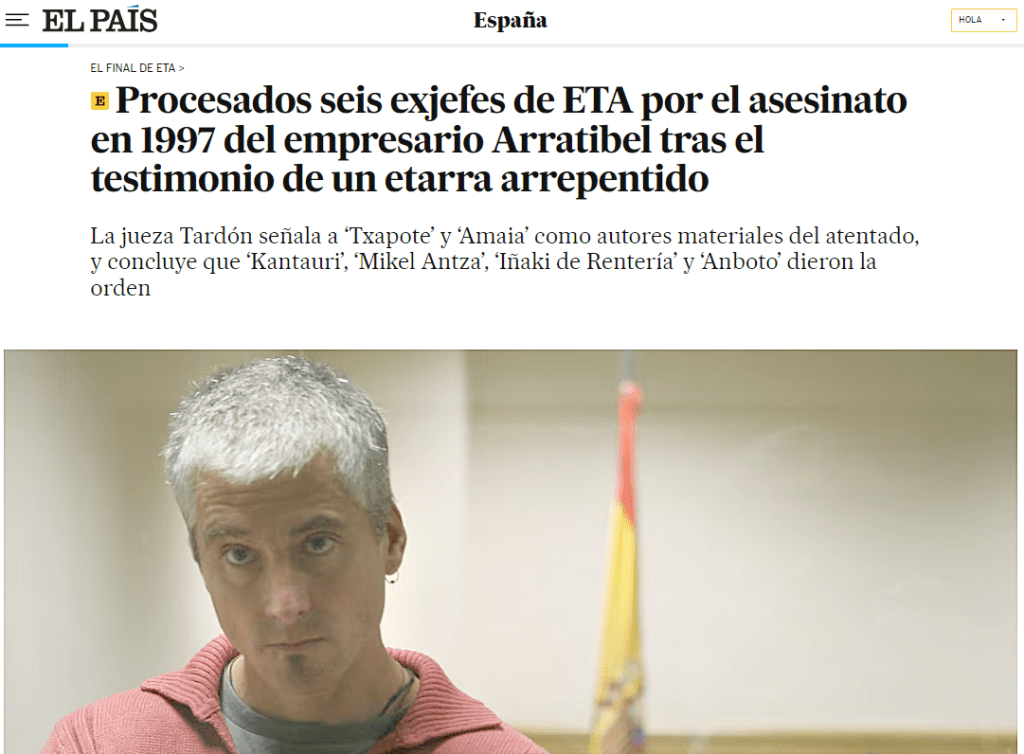
Translation of the El Pais story below:Oscar Lopez-Fonseca 09 JUL 2024
New judicial front against the former leadership of ETA, this time for one of the more than 200 crimes of the terrorist organization that remained unpunished after the dissolution of the band in 2018.
The judge of the National Court María Tardón has issued an order indicting six former leaders of the terrorist organization for the murder with a shot to the back of the head, on February 11, 1997 in Tolosa (Gipuzkoa), of the businessman Francisco Arratibel whom the organization had accused of appropriating 60 million pesetas (360,600 euros) from the rescue of the industrialist Emiliano Revilla, kidnapped in 1988.
Two of them, Francisco Javier García Gaztelu, alias Txapote , and his partner, Irantzu Gallastegui, Amaia , are accused of being the material authors of the attacks, while the other four – José Javier Arizcuren Ruiz, Kantauri ; Miguel Albisu Iriarte, Antza; Ignacio Miguel Gracia Arregui, Iñaki de Rentería , and Soledad Iparraguirre, Anboto ― are considered members of the ETA Committee during the period in which the attack was decided, planned and carried out.
The judge has summoned the six on 24 July to inform them of the indictment and to take their statements.
According to the magistrate in her ruling, the investigation recently received a boost when the testimony of one of the two repentant terrorists who last year acquired the status of protected witnesses when they began to collaborate with the justice system in the clarification of attacks, as well as an intelligence report from the Civil Guard, were incorporated into the summary. In recent years, several judges of the National Court have relaunched nearly a dozen cases against former members of the ETA leadership as indirect perpetrators (a kind of instigators who had absolute control) of different attacks…
In 2014, the victim’s family provided a press clipping stating that ETA member Francisco Elejalde, who had been arrested and convicted for the murder of Francisco Gómez Elósegui in March 1997, just one month after Arratibel’s death, had identified the two members of the Donosti commando with whom he had collaborated during that period.
So it cannot be argued by McDowell that there was no other option but to enact an Amnesty without precondition for the IRA and its Army Council leaders – the evidence of Spain’s judges prosecuting ETA’s Army Council equivalent on behalf of victims of ETA’s terrorism in 2024 is the clearest proof that the Peace Process in Ireland could have been so different for innocent victims of IRA terrorism.
McDowell and Bertie Ahern are the living proof of the Irish state’s betrayal of victims of IRA terrorism.
As it turns out, Michael, you were no hard man at all when it came to facing down the IRA’s Army Council terrorist leaders.
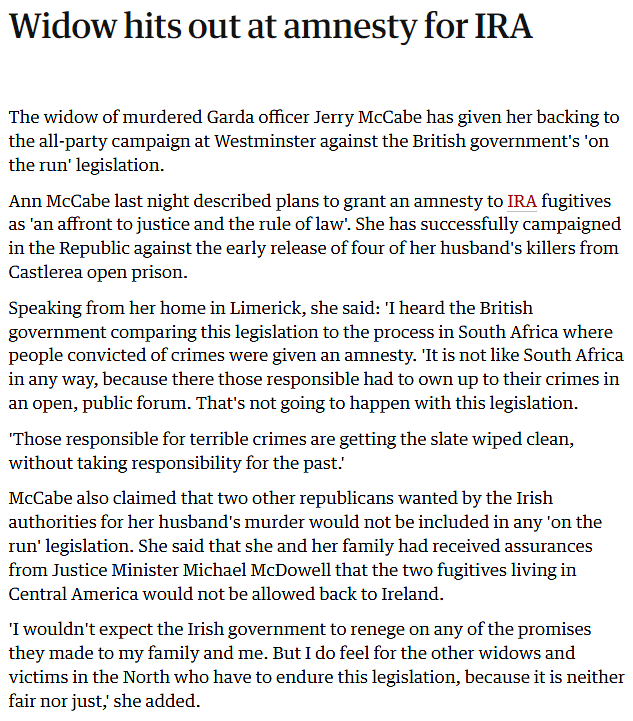
Text of Ann McCabe’s Guardian statement:
The widow of murdered Garda officer Jerry McCabe has given her backing to the all-party campaign at Westminster against the British government’s ‘on the run’ legislation.
Ann McCabe last night described plans to grant an amnesty to IRA fugitives as ‘an affront to justice and the rule of law’. She has successfully campaigned in the Republic against the early release of four of her husband’s killers from Castlerea open prison.
Speaking from her home in Limerick, she said: ‘I heard the British government comparing this legislation to the process in South Africa where people convicted of crimes were given an amnesty. ‘It is not like South Africa in any way, because there those responsible had to own up to their crimes in an open, public forum. That’s not going to happen with this legislation.
‘Those responsible for terrible crimes are getting the slate wiped clean, without taking responsibility for the past.’
McCabe also claimed that two other republicans wanted by the Irish authorities for her husband’s murder would not be included in any ‘on the run’ legislation.
She said that she and her family had received assurances from Justice Minister Michael McDowell that the two fugitives living in Central America would not be allowed back to Ireland.
‘I wouldn’t expect the Irish government to renege on any of the promises they made to my family and me.
But I do feel for the other widows and victims in the North who have to endure this legislation, because it is neither fair nor just,’ she added.
 The Irish Peace Process